In a thousand Golden Age stories, the correct answer to a warning sign in deep space is to keep flying.
You know the scene. The klaxons are blaring, casting harsh red shadows across the steel bulkhead. The navigator wipes sweat from his brow, begging the commander to turn back. But the captain—jaw set, eyes fixed on the impossible void—pushes the throttle to the maximum. The bold survive. The cautious stagnate. Retreat isn’t just a tactical choice; it’s a moral failure.
It’s the Manifest Destiny of the stars. It’s that deeply American, highly optimistic myth that space is just another frontier, and boundaries only exist to give humanity something to cross.
But what happens when the universe disagrees?
What happens when you cross a line, and the thing waiting on the other side isn’t a villain you can outsmart, but a security system you can’t even comprehend?
In Dane Forsythe’s Earth Crossed the Enforced Boundary, we get a chilling answer.
It’s a story that takes the genre’s most heroic instinct—the drive to push forward into the unknown—and turns it into a lethal transgression.
(Full disclosure: Forsythe is my fiction pen name, but I’m writing about it here because it sits squarely in a tradition this site has been tracing across multiple posts, and it earns its place in that conversation.)
The Shadow of Manifest Destiny
To understand the shock of Forsythe’s narrative, we have to look at the foundation it’s shaking.
If you grew up hunting for dog-eared paperbacks with painted covers, you know the tradition. Astounding Science Fiction, John W. Campbell, Robert A. Heinlein. They built their empires on the concept of the “competent man.”
Heinlein’s heroes—from the roughnecks of Starship Troopers to the pioneers of Time Enough for Love—are celebrated for pushing past the limits that lesser people respect. Campbell’s entire editorial philosophy was anchored in the idea that humanity is special, human ingenuity always wins, and the universe bends to the determined mind.
The classic first-contact story was essentially a pioneer narrative wrapped in beryllium steel. We approach. We communicate. We prevail through sheer grit.
But there has always been a shadow in the genre. A quieter, more skeptical counter-tradition running alongside the pulp energy. Think of Murray Leinster’s “First Contact” in 1945—available in most vintage SF anthologies, including The Science Fiction Hall of Fame—which literally named the trope but is fundamentally about the agonizing terror of contact, the paralyzing realization that a single mistake could mean the annihilation of a species. Think of Stanisław Lem’s entire body of work, where the universe consistently punishes human arrogance and our assumption that we are the center of the galactic drama.
And then there’s Captain Rourke.
The Warden vs. The Explorer
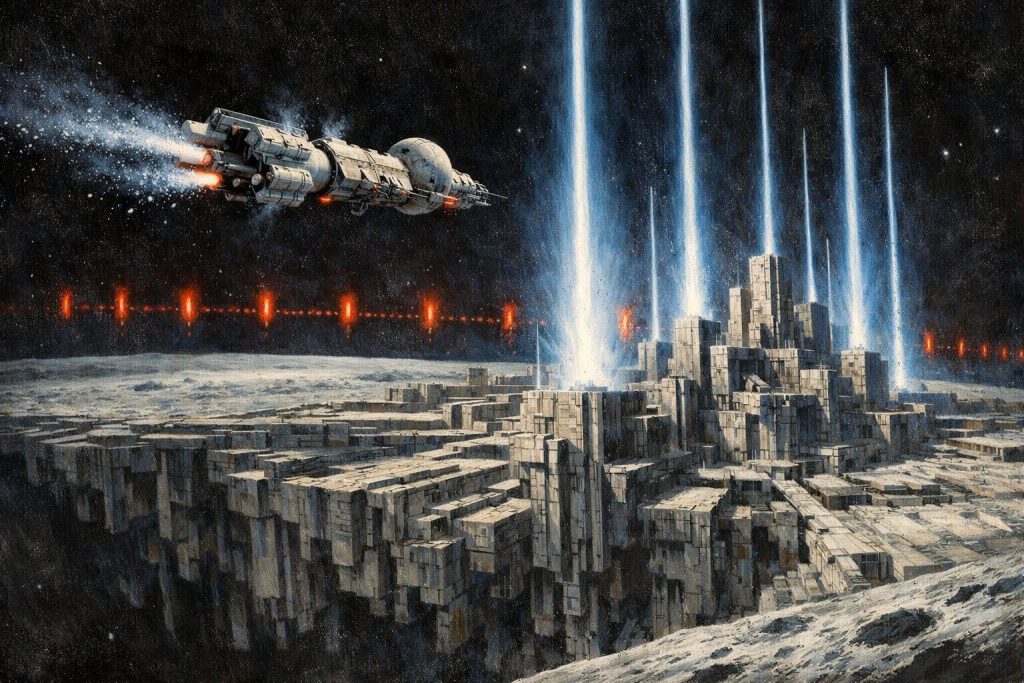
Let’s step onto the bridge of the Frontier’s Edge. The air smells faintly of recycled oxygen and hot circuitry. Through the main viewport, a sprawling alien architecture rests on an ancient moon. The boundary markers have been crossed.
By the standards of Golden Age science fiction, Captain Rourke is doing everything right. He isn’t some arrogant fool; he is disciplined, tactically brilliant, and refusing to be intimidated by a “No Trespassing” sign from ten thousand years ago. He presses forward. He gathers data. He attempts communication across multiple frequencies.
And within the first hour of engagement, five of his crew members are violently dead.
The horror of this sequence doesn’t come from a traditional space battle. It comes from the absolute, chilling logic of his opponents. We’ve talked before about the bureaucratic auditors in Case Study #11,847, and the passive cognitive traps in The Warning That’s Also a Trap. But the entities enforcing this boundary are something different. They are professionals.
They don’t hate Rourke’s crew. They aren’t monsters looking to feed, nor are they offended gods looking for worship. As the Frontier’s Edge shudders violently under a barrage of alien fire, Rourke stares at his telemetry in cold realization.
“They were disabling, not destroying.”
Every shot is surgical. They target the propulsion drives. They blind the sensor grids. When a sudden hull breach vents three crew members out into the unforgiving vacuum of space, it isn’t presented as an atrocity. It’s an acceptable casualty in a routine enforcement action. To the aliens, the Frontier’s Edge isn’t an embattled ship of heroes. It’s a stray animal that wandered onto a high-security military base.
Wiping a smear of blood from his console, Rourke finally names it: “This isn’t an attack. It’s enforcement. They’re wardens.”
If the aliens are wardens, then humanity isn’t the bold explorer. We’re just the local wildlife being kept away from the expensive equipment.
The Limits of Competence
For those of us who revere Military SF, this is the story’s real emotional core. We love the deeply satisfying machinery of competent command… the commander who reads the situation, adapts when outgunned, and leads his people through the fire. It’s why we still hunt down pristine copies of Gordon Dickson’s Dorsai!
But Military SF has always had a self-questioning wing. Joe Haldeman’s The Forever War stripped away the Heinlein mythology by showing us a soldier who does everything perfectly and still can’t control the outcomes of a war shaped by forces he can’t comprehend.
Rourke is living that nightmare. His training, his tactical instincts, his leadership… all excellent, and all completely irrelevant against an enforcement force operating on an entirely different scale. He uses his sensors correctly. He protects his people flawlessly within the parameters of human capability. But against the wardens, human capability is a rounding error.
He isn’t being fought. He’s being processed. The most unsettling kind of opponent isn’t the one that wants to kill you. It’s the one that finds you too irrelevant to bother with a formal declaration of war.
The Final Question
The story earns its place in the vintage canon not just through its kinetic, surgical combat, but through its aftermath. There is no triumphant counter-attack. There is no brilliant human ingenuity that bypasses the alien shields. There is only survival.
As the Frontier’s Edge limps back across the boundary line, its systems crippled and its cargo bay holding five frozen bodies, Rourke looks back. The massive structures on the ancient moon are powered up, humming with a cold, indifferent energy. The dead are gone, and the hero’s instinct got them killed.
Rourke is left with a thought that feels like a physical weight in the stomach: What required a ten-thousand-year quarantine? What were they keeping out… or what were they keeping in?
The story doesn’t answer it. It just leaves you there in the dark, watching the boundary markers fade into the distance, wondering if the best thing you can do when you see a “No Trespassing” sign in deep space… is to simply turn around.
Want to dive deeper into the Golden Age paperbacks that shaped us? Join the newsletter for monthly curations, edition hunting tips, and a community that actually wants to talk about Stanisław Lem at dinner parties. The boundary markers are clearly labeled.
The “Enforced Boundary” Syllabus
If you’re interested in stories that challenge the “Manifest Destiny“ of the stars and the limits of human competence, start here:
- Read: The Forever War by Joe Haldeman. The definitive text on the limits of military competence. A brilliant, tragic look at a conflict where human training means nothing against cosmic scale and time dilation.
- Read: Childhood’s End by Arthur C. Clarke. For the “benevolent enforcer” alien archetype. It asks a deeply uncomfortable question: Is being “protected” by a superior species a gift, or just a comfortable cage?
- Watch: Annihilation (2018). We’ve mentioned it in this series before, but it belongs here too… specifically for the moment the expedition crosses into the Shimmer and immediately begins losing the ability to leave. The trespass and the consequence arrive simultaneously.
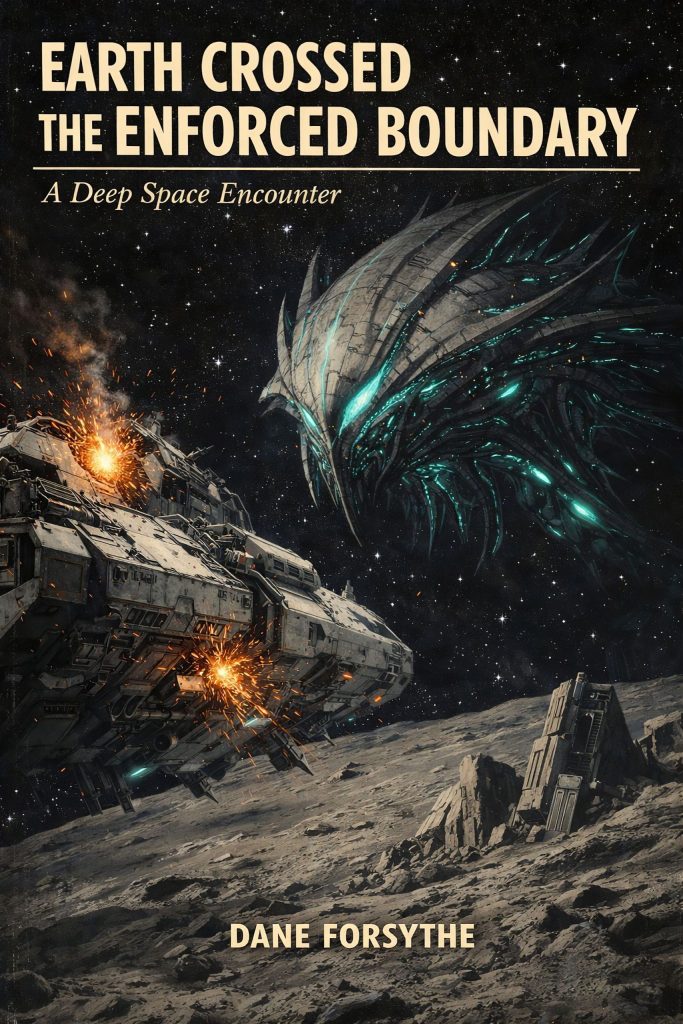
- Read: Earth Crossed the Enforced Boundary by Dane Forsythe. A tight, single-sitting look at what happens when the frontier mentality hits a brick wall of indifferent, superior technology.
Disclosure: As an Amazon Associate, I earn from qualifying purchases.