The inspector didn’t look for our cathedrals. He didn’t care about the moon landing, the symphonies, or the way the light hits the Pacific at sunset. He didn’t ask to be taken to our leaders. Instead, he stood in the dust of a ruined street in Aleppo, watched the smoke drift over the broken concrete, and quietly checked a box on a digital clipboard. No death rays. No dramatic ultimatums. Just an audit, completed in silence.
In the long, rich lineage of first contact science fiction tropes, we’ve mostly been told a very flattering lie. The lie is that humanity is special. We’re the plucky underdogs of the cosmos. We’re the scrappy species with undeniable “potential.”
If you grew up chewing through the Golden Age giants—Asimov, Heinlein, and the John W. Campbell editorial machine (new to these names? Start here)—you know the vibe perfectly.
Humanity is destined for the stars. We might be messy, our history might be soaked in blood, but our indomitable “spirit” is our secret weapon. We’re the X-factor that surprises the ancient, stagnant galactic empires.
Whether it’s the benevolent tutors of Clarke’s Childhood’s End or the cryptic mathematicians of Sagan’s Contact, the core assumption in classic SF remains the same: we have something worth saving. Or at least, something worth explaining. It’s a comfortable trope. It’s affirming. It’s also, if we’re being honest, a bit colonial.
But by the time the New Wave hit the shores of the genre in the 1960s, writers like J.G. Ballard and Thomas Disch started poking holes in that balloon.
They looked around at the Cold War, the environmental degradation, and the sheer bureaucracy of modern life, and they suggested something far more unsettling…
What if aliens finally showed up, took one look at our civilization, and found us pathologically insular?
Or worse… just plain irrelevant?
What if we aren’t the protagonists of the universe? What if we’re just Case Study #11,847, and the galactic inspectors are already bored?
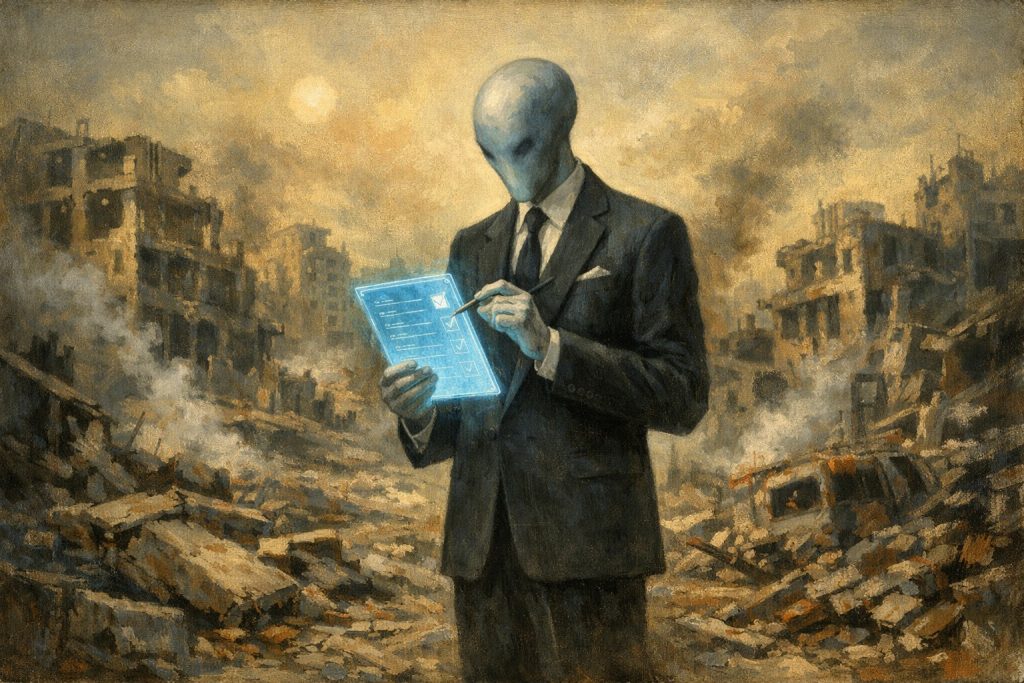
The Uplift Story Stood on Its Head
That specific, uncomfortable nerve is the subject of Earth Failed Its First Inspection by Dane Forsythe. (Full disclosure: Forsythe is my fiction pen name but I’m writing about it here because it sits firmly in a genre tradition I love, and one we discuss constantly on this site).
The story takes the classic “Uplift” trope—the optimistic idea that a higher intelligence is here to pull us into a grander destiny—and stands it completely on its head. In this inversion of the formula, the “Galactic Inspection” isn’t a miraculous opportunity to prove our worth. It’s an administrative review. And humanity is deep in the red.
Every great first-contact story needs a bridge. A focal point. Think of Shevek in Le Guin’s The Dispossessed or the beleaguered linguists in Ted Chiang’s Story of Your Life. These characters represent the best of us: intellectuals who desperately believe that if we can just communicate clearly enough, we can solve the crisis.
In Forsythe’s story, that burden falls on Dr. Okonkwo. She is the classic humanist protagonist… patient, brilliant, and deeply invested in the idea that humanity’s failures are just “misunderstandings” or “growing pains” on the way to maturity. She embodies the Campbell-era confidence that our better nature will ultimately win out.
There is a very specific kind of heartbreak in watching a character realize their core philosophy is obsolete.
It’s a theme Stanisław Lem mastered in Fiasco and His Master’s Voice… the crushing, suffocating weight of the “Silent Universe.” The tragedy of Dr. Okonkwo isn’t that the aliens lack the technology to understand us. It’s that they understand us perfectly, and they simply don’t care.
When the inspector delivers his verdict to her, it’s not a villainous monologue. It’s a clinical observation. He tells her: “The problem is not misunderstanding. The problem is choice.”
That line cuts right through the optimism of those mid-century classics. It suggests that our tragic “flaws” aren’t bugs in our societal system that a higher intelligence can patch with cold fusion or a shiny new philosophy. They are features. Features we have actively chosen to keep. It has the moral clarity of the best Twilight Zone episodes… the universe as a system that simply does not negotiate with sentiment.
The universe doesn’t care about your excuses. It only cares about the data.
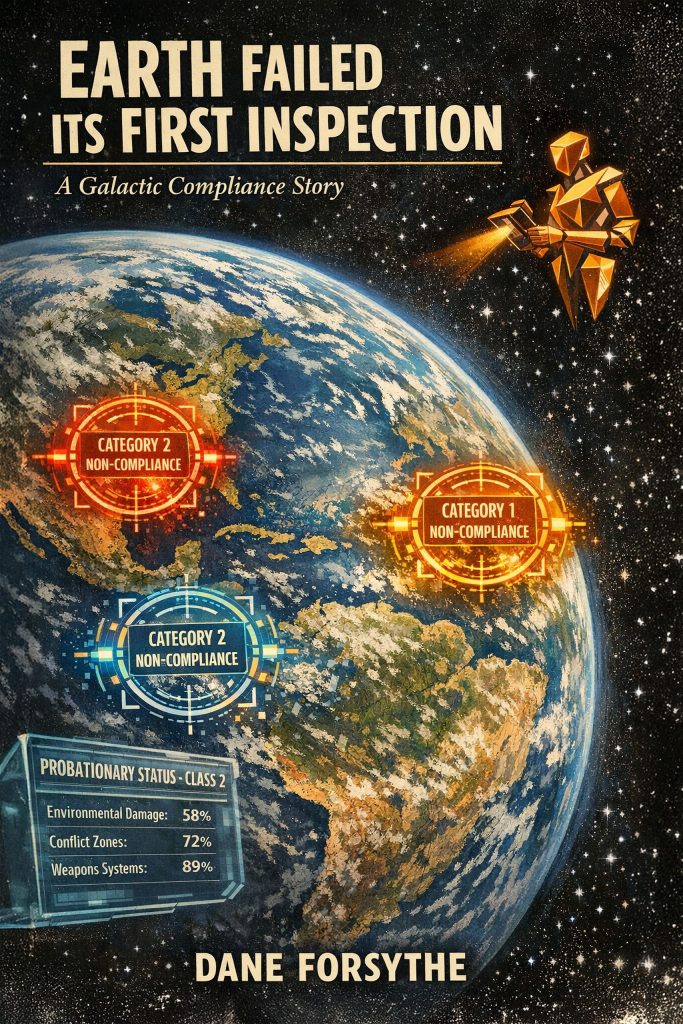
Bureaucratic Cosmic Horror
We’ve talked before on the site about how the most terrifying alien invasion in science fiction isn’t a tripod laser… it’s a filing cabinet. There is a distinct subgenre of SF that deals with the “Bureaucracy of the Stars.” It’s Kafkaesque. It captures the modern anxiety of having your entire civilization judged by a set of criteria you weren’t allowed to read, processed by an entity that is technically doing its job but has exactly zero empathy for its subjects.
The aliens conducting the inspection aren’t malevolent conquerors. They don’t want our gold, our water, or our atmosphere. They are purely administrative. They’ve seen thousands of worlds hit the “Industrial Threshold.” They’ve seen thousands of species build nuclear weapons before they bothered to build equitable food systems. To them, we aren’t a unique, romantic tragedy. We’re a rounding error.
In the 1950s, the “alien judge” narrative—think of Klaatu in The Day the Earth Stood Still—was a stern warning: Be better, or we will stop you.
In this newer, colder iteration of the theme, the warning shifts into something far bleaker: We aren’t going to stop you. We’re just going to leave you to rot in the waiting room.
The Mirror We Need
Why does this specific angle—the “Impressed-By-Nothing Alien”—feel so much more resonant today than the “Star-Child” ending of 2001: A Space Odyssey?
Maybe it’s because we’ve reached a point where “we didn’t know” is no longer a viable defense.
We have the satellite data on the reef collapse.
We have the casualty figures.
We have forty-seven active armed conflicts and a complete archive of diplomatic frameworks for ending every single one of them.
We aren’t ignorant. We’re just busy.
When you and I sit down in our reading chairs with a piece of science fiction, we aren’t really looking for a square-jawed hero to save the day with a clever speech about “The Human Spirit.” We’re looking for a mirror.
If you appreciate Solaris—the ocean that is simply too vast and too alien to care about our neuroses—you’ll recognize the territory immediately. First-contact stories aren’t really about the aliens. They are about the metrics we use to judge ourselves.
If you want to see this old genre debate given a sharp, modern edge, Earth Failed Its First Inspection is a short read available on Kindle. It’s a quick hit to the system, meant to be read in a single sitting. If you want to make a weekend out of this specific subgenre, here is your syllabus:
- Read: Fiasco by Stanisław Lem (for the ultimate “communication failure” experience).
- Watch: The original 1951 The Day the Earth Stood Still (to see the blueprint the inspector subverts).
- Read: Earth Failed Its First Inspection by Dane Forsythe (for the modern, administrative audit of those old tropes).
Sometimes, the most interesting question science fiction can ask isn’t “Are we alone?” It’s “If we aren’t, why would they ever want to talk to us?”
Just remember: keep your shelves organized, protect your paperbacks from direct sunlight, and keep your cynicism well-earned. The inspectors could be here any day.
Disclosure: As an Amazon Associate, I earn from qualifying purchases.