Philip K. Dick wrote 44 novels and more than 120 short stories before his death in 1982. Most of those novels were written fast, under financial pressure, for paperback advances that barely covered his rent. A handful are minor. Some are rough around the edges. And about a dozen are among the most important works of fiction produced in the twentieth century.
The problem for new readers? Figuring out which is which.
This ranking focuses on the novels that best demonstrate what makes Dick essential: the paranoid reality-slippage, the ordinary men caught in extraordinary metaphysical crises, the compassion for broken people, the persistent question of what it means to be human. These are the ten you read first, collect first, and think about longest.
A note on this list: it ranks novels by their literary significance, readability, and lasting impact—not by market value or rarity. For collecting advice on specific editions, see our guide to starting a vintage sci-fi collection.
#10: Time Out of Joint (1959)
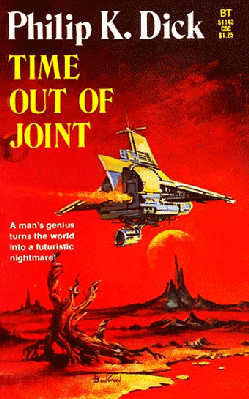
The one to read if you want an accessible entry point to early Dick.
Ragle Gumm wins a newspaper contest every day. He’s very good at it. He lives quietly in a small American town in what feels like the late 1950s, and everything is fine… until a soft drink stand disappears and leaves behind a slip of paper that says “SOFT DRINK STAND.”
Time Out of Joint is Dick’s first major novel and one of his most readable. The paranoid unraveling is controlled and deliberate. The suburban setting—so normal it aches—makes the strangeness more effective. This is the book to give someone who’s never read Dick and isn’t sure they’re ready for the deep end.
Why it made the list:
- Accessible plot structure (rare for Dick)
- First major expression of his core theme: reality is constructed, and someone else controls the construction
- Historically important—predates The Truman Show by 40 years
Recommended edition: Vintage Books trade paperback. Paperback on Amazon | Kindle edition
Collector note: Original Lippincott hardcover (1959) is rare at $150+. More realistic: the 1965 Belmont paperback with vintage cover art. Search vintage editions on eBay
#9: Dr. Bloodmoney (1965)
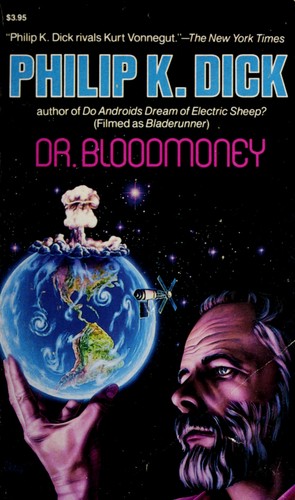
The one that shows his range beyond paranoid thrillers.
Set in a post-nuclear California, Dr. Bloodmoney follows a sprawling cast of survivors rebuilding after the bombs. It’s warmer than most Dick novels… almost optimistic, in a scarred way. A little girl carries her dead twin brother inside her body, speaking to her. A man orbiting the earth in a satellite tries to get home. A charismatic villain may have caused the war through sheer will.
This novel doesn’t get talked about enough. It shows Dick could write community, not just isolated paranoid protagonists. The characters feel genuinely human in ways that transcend genre.
Why it made the list:
- Dick’s most humane novel
- Undervalued by casual readers—beloved by serious fans
- Demonstrates his range: this isn’t the Dick of Do Androids Dream
Recommended edition: Vintage Books paperback. Paperback on Amazon | Kindle edition
Collector note: Original Ace paperback (1965) with Frank Freas cover is affordable—sometimes around $15-35+ in Good condition. Search vintage editions on eBay
#8: Flow My Tears, the Policeman Said (1974)
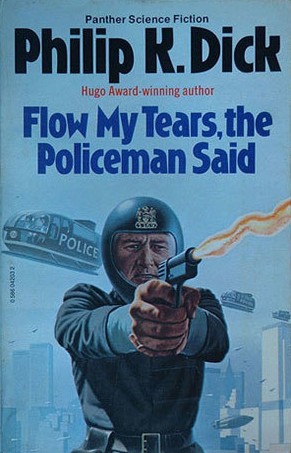
The one that breaks your heart while confusing you pleasantly.
Jason Taverner is a famous television star with 30 million viewers. He wakes up one morning and no one knows who he is. No records. No ID. He has simply been erased from the world’s memory. He must survive in a near-future police state without the identity that defined him.
This novel won the John W. Campbell Memorial Award and is arguably Dick’s most emotionally resonant work. The ending is genuinely moving in a way that sneaks up on you. The police state backdrop is vivid and believable.
Why it made the list:
- Campbell Memorial Award winner
- Most emotionally affecting of his novels
- The identity-erasure premise still feels urgent
Recommended edition: DAW or Vintage Books paperback. Paperback on Amazon | Kindle edition
Collector note: Original DAW paperback (1974) with Don Ivan Punchatz cover is gorgeous—$20-45+ in VG condition. Search vintage editions on eBay
#7: VALIS (1981)
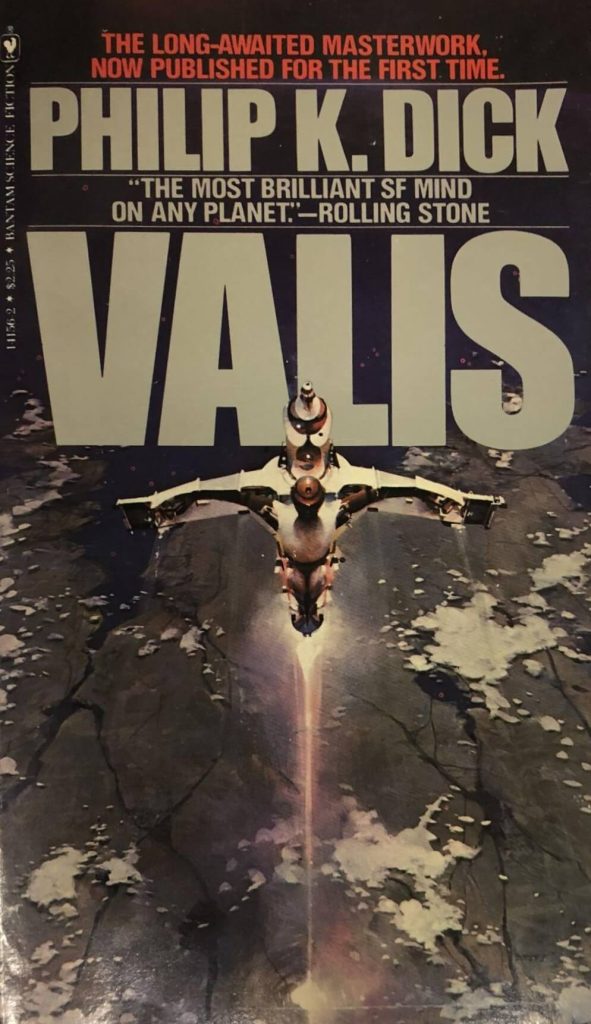
The one that requires patience and rewards it.
In February and March of 1974, Philip K. Dick experienced a series of visions he spent the rest of his life trying to explain. VALIS is his attempt to turn that experience into fiction… a novel in which a character named “Philip K. Dick” encounters a satellite transmitting divine information from ancient Rome.
This is the strangest book on this list. It is also one of the most searching novels about religious experience and the nature of God written in the twentieth century. Dick isn’t playing with these ideas… he’s genuinely trying to work something out. That urgency is palpable on every page.
Why it made the list:
- Unique in American literature: a serious theological novel in science fiction form
- First book of his final trilogy (followed by The Divine Invasion, The Transmigration of Timothy Archer)
- Autobiographical in ways that make it hurt
Recommended edition: Vintage Books paperback. Paperback on Amazon | Kindle edition
Collector note: Original Bantam paperback (1981) is affordable and easy to find—$8-20+. Search vintage editions on eBay
#6: Martian Time-Slip (1964)
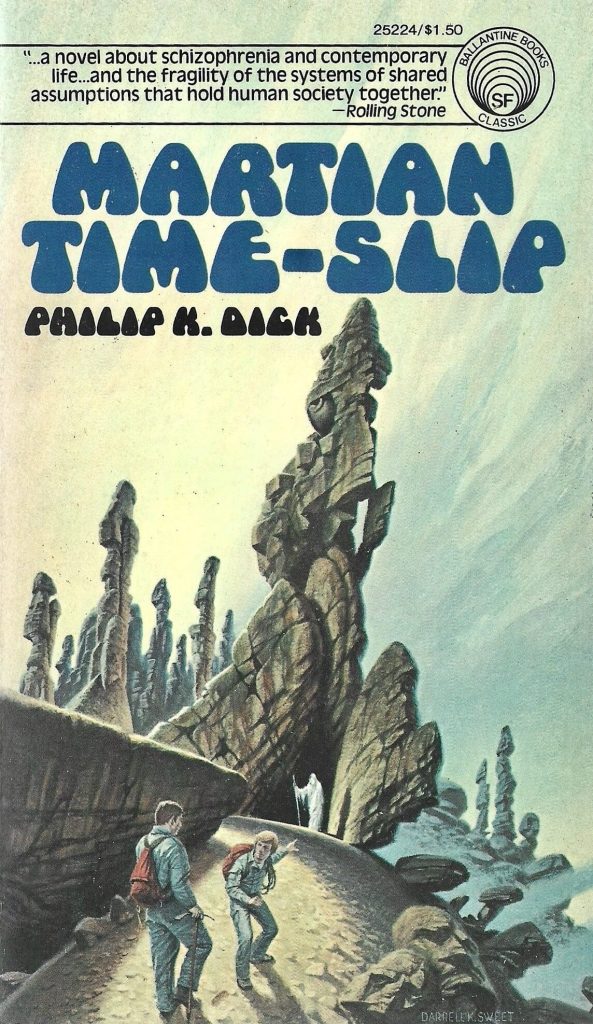
The underrated masterpiece. The one serious readers always name.
On a colonized Mars, a repairman named Jack Bohlen tries to navigate a corrupt real estate deal while a Martian boy named Manfred Steiner experiences time non-linearly… living simultaneously in the past, present, and future, including his own death.
Ask serious PKD readers which novel is underrated and this is the answer you’ll get most often. The prose is controlled. The structure is formally ambitious. The treatment of Manfred’s condition—rendered decades before contemporary understanding—is surprisingly compassionate. This is Dick working at full power with maximum craft.
Why it made the list:
- Formally ambitious structure (Manfred’s sections shift time deliberately)
- Dick’s most technically accomplished novel
- The one that rewards re-reading most
Recommended edition: Vintage Books paperback. Paperback on Amazon | Kindle edition
Collector note: Original Ballantine paperback (1964) is sought-after but still affordable—$20-50+ in Good condition. Search vintage editions on eBay
#5: The Three Stigmata of Palmer Eldritch (1965)
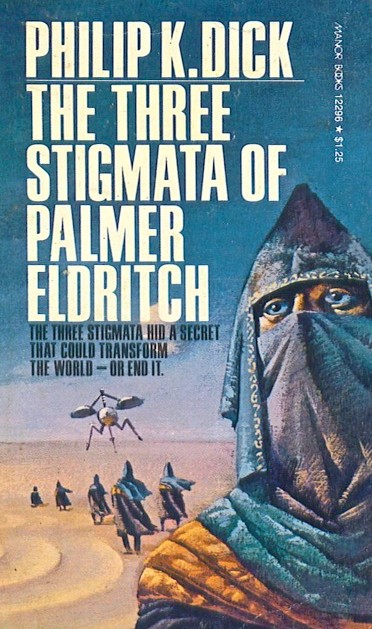
The darkest. The most theologically unsettling. The one that stays with you.
In a future of mandatory Mars colonization, humans endure brutal conditions by using a drug called Can-D that lets them briefly inhabit the bodies of Barbie-and-Ken-like dolls. A new drug appears: Chew-Z, marketed by the mysterious Palmer Eldritch, who may have encountered something out in the Prox system. Something that wasn’t human.
This is the PKD novel where the horror never resolves. The ending offers no comfort. Eldritch’s three stigmata—the artificial arm, the slit-scan eyes, the stainless steel teeth—begin appearing on other characters, suggesting something has gotten in, something has spread. It’s an alien possession story, a drug parable, and a meditation on whether God can be evil, all at once.
Why it made the list:
- His most explicitly religious horror novel
- The unresolved ending is deliberate and brave
- Palmer Eldritch is one of the great villains of American fiction
Recommended edition: Vintage Books paperback. Paperback on Amazon | Kindle edition
Collector note: Original Doubleday hardcover (1965) commands $100-200+. Ace paperback (1966) is more achievable at $25-60+. Search vintage editions on eBay
If the alien-contact-as-existential-threat premise grips you, Dane Forsythe’s The Nebula Raiders explores similar territory in pulp-adventure form.
#4: Do Androids Dream of Electric Sheep? (1968)
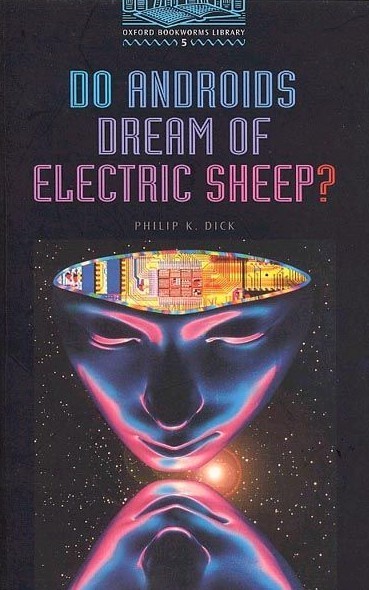
The famous one. The Blade Runner source. Still better than the film.
Rick Deckard is a bounty hunter tasked with “retiring” six escaped Nexus-6 androids on a post-nuclear Earth where real animals are status symbols and artificial empathy is dispensed through a mood organ. The androids are nearly indistinguishable from humans. Deckard isn’t entirely sure he isn’t one.
The film adaptation (Blade Runner) is a masterpiece, but it strips away Dick’s central concern: empathy as the defining human quality. The novel asks whether empathy can be manufactured… and whether it matters if it can. Mercerism, the shared religious experience that connects all humans, gives the book a spiritual dimension the film ignores.
Why it made the list:
- The most culturally significant Dick novel (Blade Runner)
- The empathy question is more urgent than ever
- First published in an affordable Signet edition that’s now collectible
Recommended edition: Ballantine or Del Rey paperback. Paperback on Amazon | Kindle edition
Collector’s note: Original Doubleday hardcover (1968) is the grail—$300-600+. Signet paperback (1969) is more realistic at $30-80+ in Good condition. Search vintage editions on eBay
#3: A Scanner Darkly (1977)
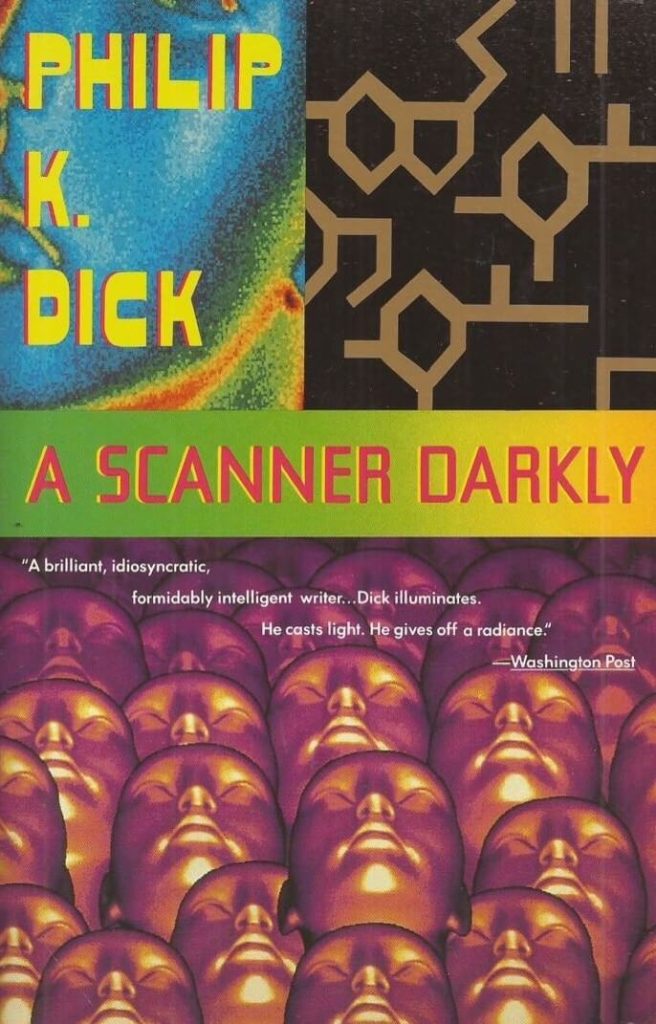
The most personal. The one with the dedication you don’t forget.
Bob Arctor is an undercover narc surveilling a group of drug users… including himself. He’s an addict too, and the scramble suit he wears to conceal his identity has a problem: he’s beginning to forget who he actually is under it. His brain is fracturing from the substance he’s supposed to be investigating.
A Scanner Darkly ends with an author’s note listing Dick’s friends who were permanently damaged or killed by drug use during the years the book covers. It is a work of grief and guilt and survivor’s conscience. The comedy in the first half is genuine… and makes the tragedy of the second half land harder.
Why it made the list:
- The most autobiographical of his novels
- The dedication is one of the most moving things in American literature
- Structurally unusual: genuinely funny, then genuinely heartbreaking
Recommended edition: Vintage Books paperback. Paperback on Amazon | Kindle edition
Collector note: Original Doubleday hardcover (1977) is $50-150+. Ballantine first paperback edition is the one to find. Search vintage editions on eBay
#2: The Man in the High Castle (1962)
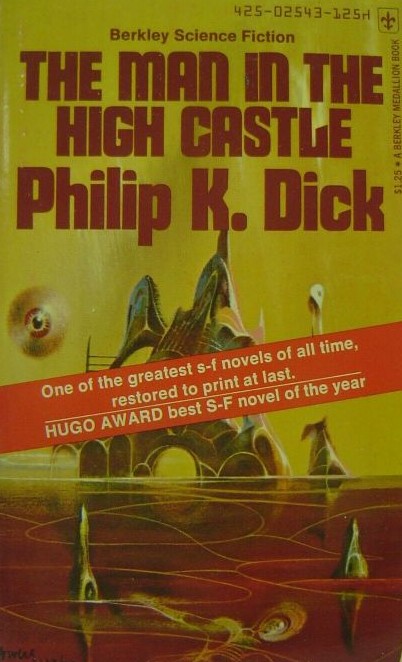
The Hugo winner. The one that earns every word of its reputation.
The Axis powers won World War II. The United States is occupied—the East Coast by the Nazis, the West Coast by the Japanese. In the Japanese-controlled Pacific States, an antiques dealer named Robert Childan struggles to find authentic American artifacts for his Japanese clientele. Meanwhile, a novel is circulating… a banned book in which the Allies won the war.
Dick’s most structurally accomplished novel. The alternate history is meticulous. The characters are among his best-realized. The use of the I Ching throughout—both as plot device and as Dick’s actual compositional method—gives the book a strange, oracular quality. The ending is deliberately unresolved in ways that have generated decades of argument.
Why it made the list:
- Hugo Award winner, 1963—his only major award during his lifetime
- His most formally sophisticated novel
- The ending is not a failure… it’s the point
Recommended edition: Vintage Books paperback. Paperback on Amazon | Kindle edition
Collector note: Original Putnam hardcover (1962) is the grail—$200-500+. Ace paperback with early cover art is achievable at $25-75+. Search vintage editions on eBay
#1: Ubik (1969)
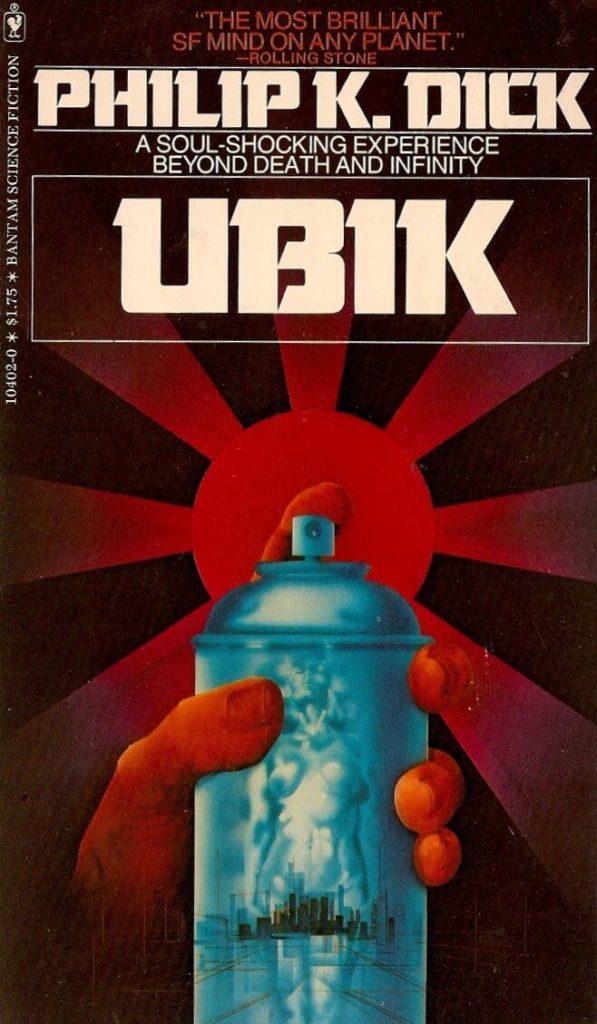
The masterpiece. The one everyone means when they say Philip K. Dick.
Joe Chip works for a company that employs anti-psychics… people whose presence neutralizes the powers of telepaths and precogs. After a mission to the Moon goes wrong, Joe’s team begins to die in bizarre ways. Reality itself starts degrading: cigarettes crumble, coffee sours instantly, appliances revert to older models. A product called Ubik appears in advertisements everywhere, promising to halt the decay.
Ubik is the novel where Dick’s central obsession achieves its fullest, most terrifying expression. Reality doesn’t just feel wrong here… it demonstrably is wrong, and the wrongness has a texture you can feel on your skin while reading. The final revelation reframes everything, but doesn’t explain everything, which is exactly right.
This is the novel critics mean when they cite Dick alongside Kafka and Borges. It’s the one that genuinely belongs there.
Why it tops the list:
- Reality entropy as narrative form… not just theme, but structure
- The advertisements for Ubik open each chapter and are genuinely funny until suddenly they’re not
- The ending is among the most discussed in science fiction
- Re-reading it changes what you thought you understood
Recommended edition: Vintage Books paperback. Paperback on Amazon | Kindle edition
Collector note: Original Doubleday hardcover (1969) is rare at $300-700+. Bantam paperback (1970) with original cover art is the collector’s target—$40-100+ in Good condition. Search vintage editions on eBay
Reading Order vs. Best-to-Worst: Not the Same Thing
This list ranks by literary significance. But if you want a reading order that builds gradually rather than starting at the deep end, here’s a different sequence:
Start here (accessible, gripping):
- Time Out of Joint
- Do Androids Dream of Electric Sheep?
- A Scanner Darkly
Then move to the classics:
- The Man in the High Castle
- Ubik
- Martian Time-Slip
Then the challenging work:
- The Three Stigmata of Palmer Eldritch
- Flow My Tears, the Policeman Said
- VALIS
Then revisit with fresh eyes:
- Dr. Bloodmoney
If you want to understand what the fuss is about as quickly as possible: read Ubik first, then The Man in the High Castle, then A Scanner Darkly. Three novels, and you’ll have the full range.
Collector’s Quick Reference
All 10 novels ranked by collecting difficulty and typical price ranges for affordable editions:
Easiest to find in collectible condition:
- VALIS (1981 Bantam) — $8-20+
- Time Out of Joint (1965 Belmont) — $12-25+
- Dr. Bloodmoney (1965 Ace) — $15-35+
Mid-range collecting targets:
- Flow My Tears (1974 DAW) — $20-45+
- Martian Time-Slip (1964 Ballantine) — $20-50+
- A Scanner Darkly (1977 Ballantine) — $25-75+
- Man in the High Castle (early Ace) — $25-75+
Serious collector territory:
- Three Stigmata Palmer Eldritch (1966 Ace) — $25-60+
- Do Androids Dream (1969 Signet) — $30-80+
- Ubik (1970 Bantam) — $40-100+
For guidance on building a focused author collection, see our complete beginner’s collecting guide.
Get More PKD and Vintage Sci-Fi Recommendations
Join the Vintage Sci-Fi Dispatch for monthly book finds, collecting tips, and deep dives into classic authors. We cover Philip K. Dick, Asimov, Le Guin, Heinlein, and the full range of golden age and New Wave science fiction.
Related Resources
- How to Start Collecting Vintage Sci-Fi Paperbacks — Find first editions and vintage PKD paperbacks.
- Where to Buy Vintage Sci-Fi Books Online — Best marketplaces for PKD hunting.
- How to Store & Protect Vintage Paperbacks — Keep your PKD collection safe.
- Dane Forsythe Fiction — Original sci-fi in the tradition of the golden age masters.
Disclosure: As an Amazon Associate, I earn from qualifying purchases.