The most unsettling sentence in science fiction isn’t “They’re here.” It isn’t “We’re alone,” or even “The airlock is failing.”
It’s “Do not attempt to understand this.”
Because the moment those six words hit your retinas, the damage is already done. You’ve processed the warning. You’ve engaged the gears of your own curiosity. Your brain, that magnificent and treacherous pattern-recognition machine, has already started trying to solve the puzzle it was just told to ignore.
In vintage SF, there is a specific, razor-sharp lineage of stories where knowledge itself is the weapon. Not the death rays, not the silver saucers, and certainly not the politics. The act of comprehension is the infection vector. We call these “cognitohazards”… ideas that damage the mind simply by being perceived.
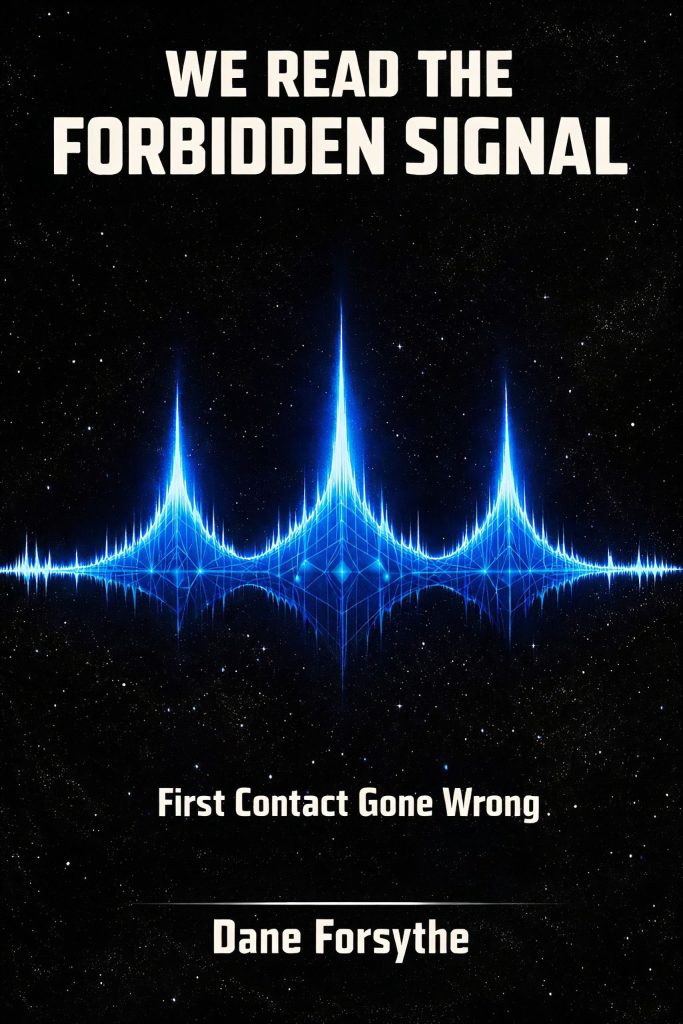
And if you want to understand how this tradition has evolved into the modern era, you need to look at a terrifying, brilliant little document called We Read the Forbidden Signal by Dane Forsythe. (Full disclosure: Forsythe is my fiction pen name — but I’m writing about it here because it sits in a tradition I’ve been tracing on this site for years, and it earns its place in that lineage.) It’s a story that sits at the intersection of Golden Age curiosity and cosmic dread, and it reminds us why some files are better left encrypted.
The “Cognitohazard” Tradition: A History of Lethal Ideas
There’s a comfort in the “Monster in the Dark” trope. You can shoot a monster. You can vacuum it out of a decompression chamber. But you can’t un-know a recursive thought.
The lineage of the cognitohazard starts, as most things terrifying do, with H.P. Lovecraft. His foundational premise wasn’t really about Cthulhu or fish-men…
…it was about the mind’s inability to survive genuine understanding.
The horror was the math. If you truly grasped the universe’s indifference, your sanity would simply snap like a dry twig. The horror wasn’t the monster; the horror was comprehension.
When SF writers of the 1950s and 60s inherited that anxiety, they did something interesting: they kept the dread and discarded the tentacles. The horror became purely conceptual.
By the 1960s and 70s, this anxiety evolved into something more intellectual and, frankly, more interesting. We shifted from “the gods are big” to “logic is a trap.”
Think of Stanisław Lem’s Solaris. The sentient ocean doesn’t attack the station with tentacles or lasers. It simply reflects human consciousness back at the crew in a physical form they can’t process or escape. The “monsters” are manifestations of their own unintegrated memories. The crew isn’t being hunted; they’re being analyzed, and it’s destroying them.
Then you have James Blish’s A Case of Conscience. A Jesuit biologist finds a world so ethically perfect — without a concept of God — that the mere existence of the planet threatens to annihilate his entire faith.
This tradition runs like a dormant virus through the paperbacks on your shelf, eventually leading to the modern “basilisk” concept in post-cyberpunk SF… images or patterns that damage the mind directly. But We Read the Forbidden Signal taps directly into the vein, crystallizing the genre in its second fragmented transmission: “Pattern recognition constitutes primary infection vector.”
It is the story naming the ghost in the machine. It’s the explicit confirmation of what Lem and Blish only whispered: that the human brain’s greatest strength is also its fatal vulnerability.
When Curiosity Becomes a Symptom
The true mechanism of dread in Forsythe’s story isn’t the mysterious beacons. It isn’t the Restricted Zone. It’s Dr. Chen.
If you’ve spent any time in the vintage SF trenches, you know her archetype. She’s the descendant of every Golden Age pulp scientist who died because they had to know one more thing before the reactor blew. We know Ahab. But the SF version of Ahab is almost always more sympathetic because they aren’t chasing revenge… they’re chasing meaning.
Unlike those classic heroes, however, Chen’s obsession isn’t a choice. It’s a compulsion.
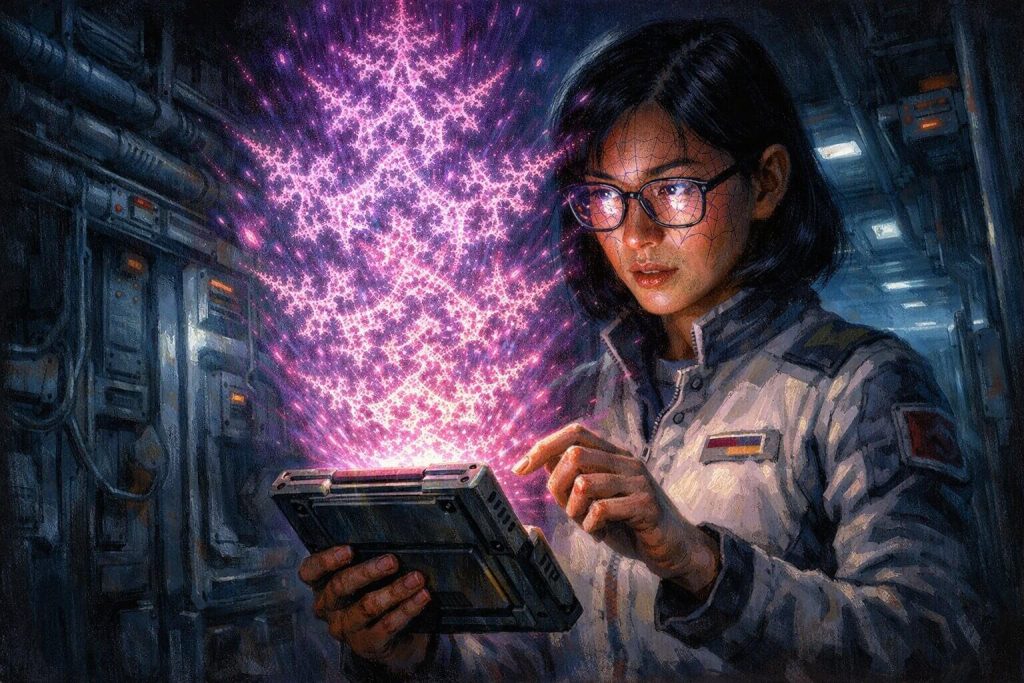
Imagine the sterile hum of the research vessel, the cold blue glow of the monitors. There is a moment in the story where Chen is walking down a ship’s quiet corridor. She holds her datapad. She opens the restricted translation file. She realizes the danger, stops herself, and closes it.
Ten seconds pass. Her thumb twitches. She reopens it.
She closes the file three times during a single walk down a hallway. She reopens it within thirty seconds each time. She isn’t looking for a solution anymore; she’s looking for the next hit of a pattern that is slowly, methodically rewriting her synapses.
The line that absolutely earns this story’s place on your shelf comes later, when Chen abstains from a crucial crew vote. Her reasoning is chilling in its stark honesty:
“I have an opinion. But it’s not mine anymore.”
That is the true, creeping dread of the cognitohazard. It’s not that it kills you; it’s that it occupies you. It replaces your autonomy with its own internal logic. It reminds me of Kelvin in Solaris, who keeps engaging with his “guest” even though he knows she’s an imitation. He does it because curiosity has stopped being a personality trait. It has become a symptom of the infection.
(For a different flavor of non-violent alien threat — the kind that arrives with paperwork instead of pattern recognition — you might enjoy The Most Terrifying Alien Invasion in Science Fiction Is a Filing Cabinet.)
The Warning That’s Also a Trap
And then the story deploys its most elegant, devastating trick.
The narrative reveals the paradox of its own existence through Fragment 4: “Message completion probability 89% upon detection.”
Pause on that for a second. Let the implications settle.
This isn’t a secret being guarded. It’s a message designed with the foreknowledge that once a human mind encounters it, that mind will — by its very nature — attempt to fill in the gaps. The warning isn’t warning humanity away. It’s the bait. It’s built to be understood, and the act of understanding it is the final step in its transmission.
It’s the dark side of Arthur C. Clarke’s 2001: A Space Odyssey. In Clarke’s universe, the Monolith activates our potential. It pushes us toward the Star Child. But in the “Forbidden Signal” tradition, that activation is a predatory act. It collapses the distinction between an invitation and a threat. It echoes Liu Cixin’s “Dark Forest” theory, or Lem’s His Master’s Voice, where the very act of trying to decode a cosmic message fundamentally changes the decoders. (It’s a tradition worth exploring further in Case Study #11,847: Bureaucratic Horror and the First-Contact Inversion, which approaches the same first-contact anxiety from a completely different angle.)
It poses a question that should make you put down your coffee and stare at the wall: If a warning is designed with the mathematical certainty that it will guarantee its own reading… is it actually a warning? Or is it an invitation to a house that’s already on fire?
You can close the file. You just can’t stay away from it.
The Syllabus: A Reading List for the Intellectually Brave
If this specific flavor of philosophical, unsettled SF is what you crave — the kind of science fiction that asks questions rather than just providing special effects — here is your starting point. These aren’t just books; they are artifacts of a deeply rewarding intellectual journey.
- Read: Solaris by Stanisław Lem. For the original “comprehension as catastrophe” experience. It remains the gold standard for how to handle an intelligence that is genuinely, fundamentally alien.
- Read: A Case of Conscience by James Blish. For the brilliant exploration of alien knowledge that destroys a man’s world simply by existing. A beautiful, tragic look at the limits of human belief systems.
- Watch: Annihilation (2018). Garland’s adaptation takes VanderMeer’s novel in its own direction, but it captures the cognitohazard dread of the source material more viscerally than almost anything else on screen. The lighthouse sequence alone is worth the price of admission.
- Read: We Read the Forbidden Signal by Dane Forsythe. For the tradition brought into a sharp, single-sitting form. An exquisite modern companion to the masters.
The characters in these stories are all looking for meaning in a universe that doesn’t care if that meaning destroys them. The pattern recognition has already started. And the opinions you have about what you’ve just read? They might not be yours for much longer.
Disclosure: As an Amazon Associate, I earn from qualifying purchases.