You know the routine by now.
You crack open a yellowed paperback…
…maybe an old Ace Double, its spine glue crumbling and its pages emitting that sweet, musty scent of decaying wood pulp…
…and you wait for the ships to drop.
The heat-rays incinerating London. The slime-dripping xenomorphs in the air ducts. The glowing motherships casting long, terrifying shadows across the Washington Monument.
In those classic stories, the narrative stakes are as primal as it gets: survive or be eaten. Fight or perish. It’s a visceral, deeply human reaction to the unknown.
But there’s another kind of First Contact hiding in the dusty corners of our collections. One that doesn’t arrive with a blinding laser blast.
It arrives with a request for a stamped triplicate.
I’m talking about the Bureaucratic First Contact.
It’s a literary tradition that’s been hiding in plain sight on our bookshelves for decades. It is the unsettling, incredibly dry realization that the universe isn’t a glorious battlefield… it’s an office.
And humanity? We aren’t the scrappy heroes of a pulp space opera. We’re just the latest entry in a cosmic backlog.
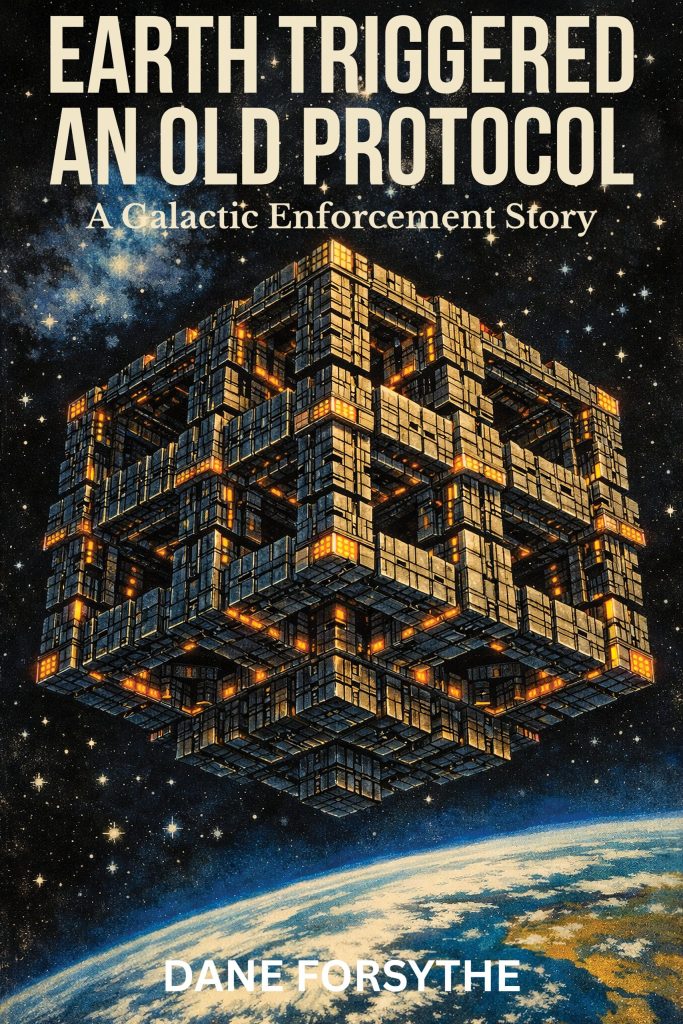
It’s a tradition I wanted to explore in my own writing… which is how Earth Triggered an Old Protocol came together. Writing it sent me back through the absurdist cosmic pranks of the Golden Age and reminded me exactly why this trope hits so much harder than a Death Star explosion.
The Kafkaesque Cosmos
Your vintage sci-fi shelf already knows this DNA. It’s a tradition of the absurd.
Think back to the procedural indifference of Douglas Adams’ “Vogons.”
You remember them… the slug-like bureaucrats who wouldn’t save their own grandmother from the Ravenous Bugblatter Beast of Traal without an order signed in triplicate, sent in, sent back, queried, lost, found, subjected to public inquiry, lost again, and finally buried in soft peat for three months.
But before the bureaucratic alien became a punchline, Stanisław Lem made it a philosophy.
In “The Star Diaries,” Lem sent the hapless Ijon Tichy careening through a galaxy tangled in cosmic red tape… interstellar committees, civilizational review boards, and procedural absurdities that made the United Nations look efficient.
It wasn’t horror.
It was something worse: the dawning realization that the universe had been organized by someone, and that someone had a filing system.
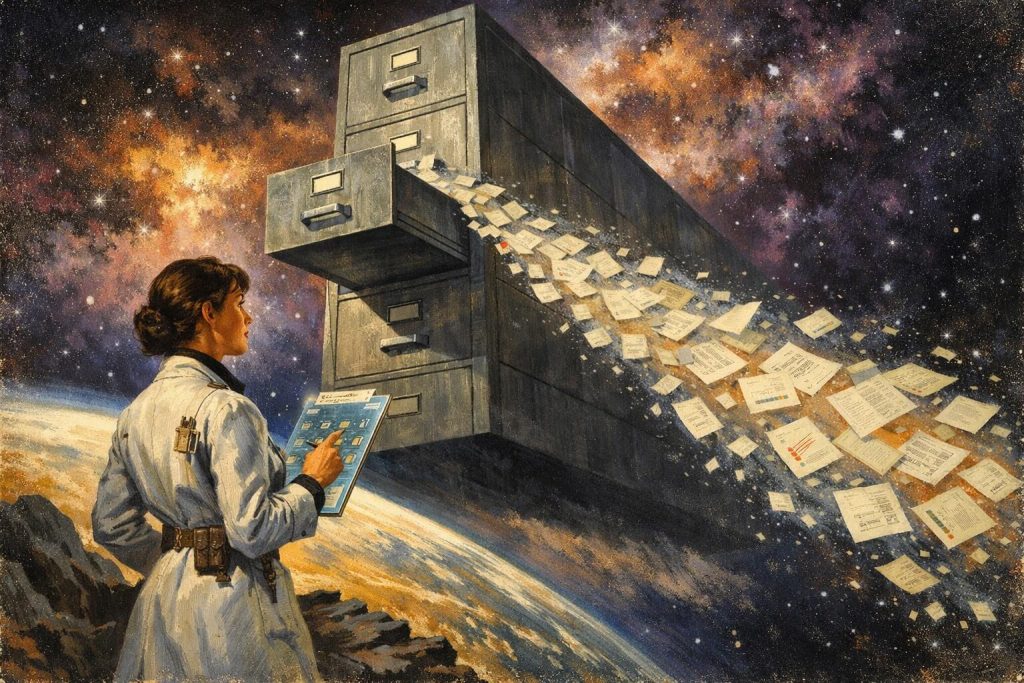
Earth Triggered an Old Protocol lands squarely in this Kafkaesque tradition. The story posits that the universe runs on ancient, dusty protocols drafted millions of years before our ancestors learned to walk upright. When we finally reach out to the stars, we don’t find the Vulcans.
We find a Help Desk that’s been on lunch break for three eons.
The horror here isn’t tentacles or death rays. It’s a compliance checklist.
The Evolution of the Competent Hero
When the universe’s ancient protocols are accidentally triggered by Earth, who do we want answering the phone on our end?
Enter Dr. Sarah Vance.
If you grew up religiously reading John W. Campbell’s “Astounding Science Fiction,” you intimately know the archetype of the “Competent Man.” The classic Heinlein or Asimov protagonist. He was the guy who could fix a failing nuclear reactor with a slide rule, a piece of chewing gum, and flawless rational logic. He never panicked. He just worked the problem.
Dr. Vance is a deliberate update to that 1950s archetype.
As the chaos begins, she’s doing exactly what a Golden Age protagonist would do: running the diagnostics. Following protocol. Thinking rationally while the politicians and generals are screaming to arm the warheads.
But as the narrative unfolds, Vance has a quiet, chilling realization. Wait, she thinks, scrolling through the incoming data streams. This isn’t a battle plan. It’s a flowchart.
This is where the archetype pivots.
In the old stories, “competence” usually meant finding the clever, hyper-logical loophole that would allow humanity to blow up the mothership and plant a flag.
But Vance faces a different kind of conflict. What does competence look like when the problem fundamentally isn’t solvable with a slide rule?
Vance has to make a call…
…not a tactical one, but a philosophical one.
She realizes the alien “invasion” isn’t an act of war. It’s an audit.
When faced with a cosmic bureaucracy totally indifferent to human existence, she recognizes that the absolute bravest, most rational thing a human can do isn’t to fight.
It’s to comply.
That pivot—from problem-solver to someone who recognizes the problem was never hers to solve—bridges the gap between classic structure and modern existential dread. Sometimes, true heroism is the crushing realization that we aren’t the center of the story.
Deep Time as a Punchline
Every veteran reader of short SF knows the rhythm of a perfect ending.
We chase the high of Isaac Asimov’s “The Last Question” or Fredric Brown’s “Answer.” You read fifteen pages of careful setup specifically for that final paragraph… the one that flips the entire narrative 180 degrees and leaves you staring at the ceiling fan in silence.
Earth Triggered an Old Protocol delivers a climax that would make Robert Sheckley proud.
The narrative tension of the story builds around a specific “response window.” Earth has triggered the protocol, submitted the requisite atmospheric data, and now must await final processing into the galactic community.
The listed processing time? A breezy 140 to 420 years.
The impending doom isn’t a fleet of star destroyers arriving to glass our cities; it’s being put on terminal hold because the cosmic switchboard is backed up.
The story’s epilogue delivers the ultimate kicker. The first actual message to reach Earth from the stars isn’t a grand philosophical manifesto. It isn’t a threat of planetary annihilation. It’s essentially an automated reply: Yes, the wait time is accurate. You really should have filed the paperwork earlier.
It makes you laugh—a dry, hacking sort of laugh—and then the sheer weight of it settles into your bones.
In the hands of authors like Olaf Stapledon, “Deep Time” is majestic. It spans beautiful eons of human evolution. But here? Deep time is just a punchline. It is weaponized administrative delay.
There is something profoundly, existentially haunting about the idea that humanity could spend centuries of technological and societal progress simply waiting for a cosmic “Authorized” stamp.
Why the Filing Cabinet Matters
As collectors and curators of the old stuff, we talk a lot about the “Sense of Wonder.”
Usually, we seek it in the physical scale of the fiction…
…the sprawling ringworlds of Larry Niven, the galactic psychohistory of Foundation, the sheer vastness of Dune.
But there is a distinct, sharp wonder in conceptual, absurdist sci-fi. The kind of story that asks:
What if the universe is exactly as messy, frustrating, and utterly indifferent as a trip to the local DMV?
We don’t read these stories for the visceral action. We read them for the speculation. For the stark reminder that the universe doesn’t owe us a glorious final battle.
If you’re tired of the endless parade of “chosen one” narratives and Marvel-style cosmic slugfests, looking back at the bureaucratic alien tradition is a breath of fresh—albeit slightly dusty—air.
You can see how a modern story like Earth Triggered an Old Protocol honors the framework built by Lem, Sheckley, and Brown, while giving the knife one final twist for our modern era.
So, go dig out a copy of Lem’s “The Star Diaries.” Track down an old Sheckley paperback. Revisit Brown’s “Answer.” Read about Dr. Vance.
You’ll soon realize that the true monsters aren’t hiding under the bed.
They’re sitting behind a desk. They’re very busy. And they’ll get to us when they get to us.
Just make sure you have your ID ready. It’s going to be a long wait.