Ever sit through a modern sci-fi blockbuster and feel completely detached from the danger?
I know the feeling. You’re watching a spaceship bridge the size of a football field. The sweeping holographic displays are flawlessly rendering galaxies. An AI concierge calmly informs the captain of a hull breach while the crew waves their hands through floating data streams like they’re conducting a symphony. It’s undeniably gorgeous.
But it doesn’t clank.
It doesn’t smell like scorched dust backing up on a vacuum tube. It lacks that sheer, terrifying fragility of being separated from the absolute zero of a hard vacuum by a thin sheet of metal and a few humming electrical relays. For those of us who grew up hunting down battered Ballantine paperbacks with the painted covers, this glossy, “magic-by-another-name” tech feels hollow. We don’t want frictionless interfaces. We want the specific, tactile anxiety that only comes when a mechanical relay clicks, a physical needle buries itself in the red, and the men on screen start sweating.
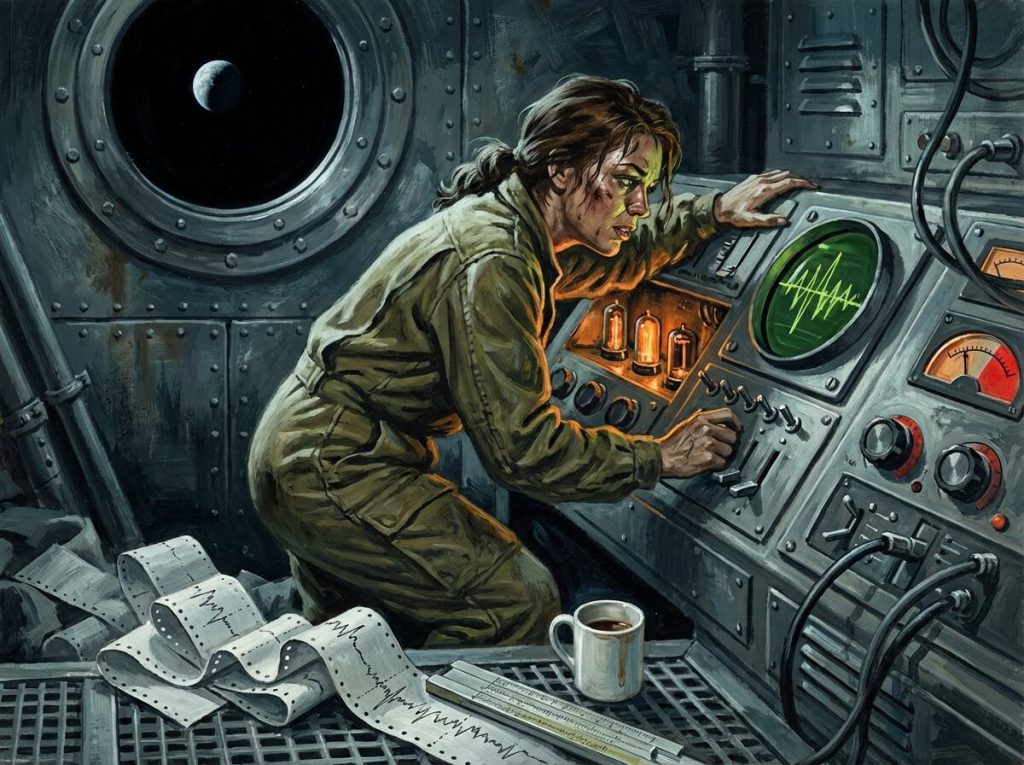
That feeling used to be everywhere. Arthur C. Clarke understood it. So did Tom Godwin, when he sat you down inside a tiny emergency dispatch ship and made you do the math alongside the pilot. Asimov’s best puzzle-box stories ran on it… not explosions, but instruments behaving wrong and smart men trying to figure out why before the clock ran out.
The structure was almost ritualistic. A small, isolated crew. A remote station perched on the absolute edge of nowhere. A technical anomaly that slowly reveals itself to be a cosmic catastrophe. The tension built through telemetry, dialogue, and the gut-twisting realization that the next adjustment to the dish wasn’t going to fix anything.
We’ve been chasing that feeling ever since the genre got swallowed by mainstream action cinema. And most modern sci-fi doesn’t even try to deliver it anymore.
Which is why I want to talk about a recent release that actually does. It’s called “The Reply From Beyond Pluto.”
The DNA of a Golden Age Throwback
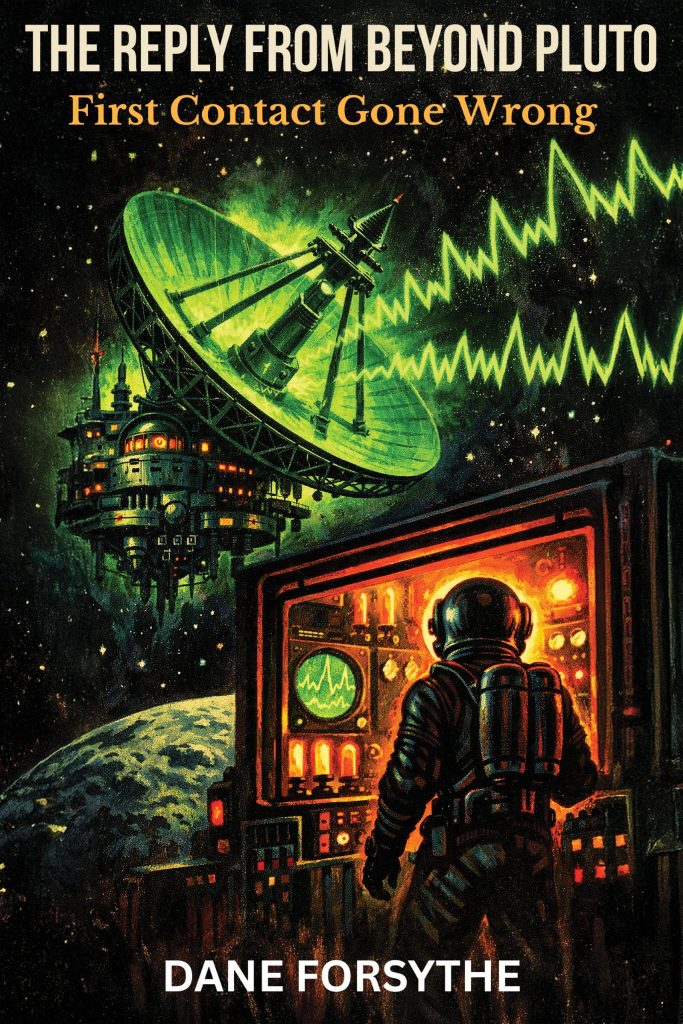 On the surface, it’s a modern book. But structurally, tonally, and deep down in its bones? This is a deliberate, unapologetic throwback to the Golden Age puzzle-box story. It doesn’t try to reinvent the wheel. Instead, it polishes the wheel until it shines like brushed steel.
Reading it feels like unearthing a lost transcript from a 1954 issue of Astounding Science Fiction. We’re tracking a lonely outpost on the fringes of the solar system… men who pick up a mysterious signal they simply can’t explain. What makes it work isn’t just cheap nostalgia. It’s the escalation. The tension here isn’t driven by laser-wielding aliens or sudden explosions. It’s driven entirely by telemetry, instruments, and dialogue. You’re right there in the room with them, poring over the star charts, checking the math, convinced that the next recalibration will finally make sense of the madness.
Think Clarke’s “The Sentinel.” Think the methodical, slow-burn engineering dread of an Asimov mystery, or the brutal, inescapable math of Godwin’s “The Cold Equations.” It’s a story that respects your intelligence, trusting that you know your way around a star chart and that you appreciate a mystery that pays off in chills rather than pyrotechnics.
Analog Tension in a Digital Age
There is a very specific kind of catnip for the vintage sci-fi collector: the aesthetic of the hardware.
Modern sci-fi treats technology as an invisible, magical utility… like Wi-Fi. It’s just there until the plot requires it to fail. But in The Reply From Beyond Pluto, the technology is a physical, heavy presence in the room. We are talking about oscilloscopes that require constant calibration. Relay racks that hum with actual, dangerous electricity. Paper printout strips chugging across the floor. The metallic, sharp smell of ozone after a short circuit.
Why does this matter? Because analog tech creates a highly specific kind of dread.
When a holographic screen glitches in a Marvel movie, it’s just a visual effect. Who cares? But when a paper chart recorder starts jittering uncontrollably in a cramped, freezing station near Pluto, you feel it in your chest. You recognize the stakes because the tech itself feels fragile. The ticking of a Geiger counter or the sudden jump of a pressure gauge is a far better soundtrack for terror than any orchestral swell.
By stripping away the invisible magic of modern UI, the story forces you back into that classic 1950s headspace: man versus the void, armed with nothing but a slide rule, a soldering iron, and his wits. This hardware-heavy aesthetic reminds us why we fell in love with this genre before it got absorbed into franchise spectacle.
The Convergence of Optimism and Indifference
If you’ve studied the history of our genre, you know the lineage at play here.
In the early days of the Golden Age, there was a profound sense of engineering optimism. The “Competent Man” trope reigned supreme. Give a trained engineer enough time, enough coffee, and enough logic, and he can solve the universe. We believed we could eventually catalog the stars and shake hands with our neighbors.
But running parallel to that was a darker, colder lineage. It’s the cosmic horror of H.P. Lovecraft, stripped of its gothic tentacles and filtered directly through the lens of hard science.
The Reply From Beyond Pluto sits perfectly at the intersection of these two ideas. It presents a crew of highly capable professionals. They do everything right. They follow every protocol. They check every backup system. They don’t make stupid horror-movie mistakes.
And yet, the answer they receive from the dark simply does not care about their competence.
This is the “Cosmic Indifference” that authors like Stanisław Lem captured so brilliantly in Solaris or The Invincible. It’s the realization that the universe isn’t a puzzle waiting to be solved by clever men. It’s the dawning horror that the “other” isn’t necessarily hostile… it’s just fundamentally, terrifyingly other. Our finest technology might just be a tin-can telephone strung up in the middle of a hurricane.
The Tradition Continues
Look, I’m the first person to tell you to hunt down the vintage mass-market paperbacks. I’d rather own ten well-loved classics than a hundred trendy new releases. We collect these things because they mean something… because they shaped how we think about the future.
But every now and then, a modern work comes along that actually understands the assignment. The Reply From Beyond Pluto isn’t a parody. It isn’t an ironic, winking take on old sci-fi tropes. It is a sincere, tightly crafted addition to the tradition of the hard SF thriller… the kind of story that makes you look up at the night sky and wonder if, maybe, the silence is actually preferable to the signal.
The Vibe Check
The Feel: 1950s Outpost Horror meets Hard SF Mystery.
Key Literary Influences: The Cold Equations, 2001: A Space Odyssey, Solaris.
Read Time: A single-sitting short read. Coffee and a quiet evening.
Best Enjoyed: In a dim room, with the faint feeling that someone else is watching the telemetry
data.
Pour yourself a drink and enjoy the clank