So, you want to start reading vintage science fiction.
Maybe you saw Blade Runner and want to read the book. Maybe you’re tired of algorithm-driven recommendations. Maybe someone mentioned Isaac Asimov and you realized you’ve never actually read Foundation. Maybe you just want to know what the fuss is about.
Here’s the problem…
There are thousands of vintage sci-fi books. Multiple golden ages. Dozens of essential authors. Pulps, paperbacks, first editions, New Wave experimentalists, hard SF engineers.
Where do you even start?
I’ve been there. Three years ago, I walked into a used bookstore with no idea what to look for. I walked out with ten books… half of them were unreadable, two were brilliant, and one changed how I think about science fiction.
This guide is what I wish I’d had then: 12 vintage sci-fi books that are actually good starting points.
Not the ‘most important’ books (some of those are genuinely rough). Not the rarest books (you can’t afford them yet, and neither can I). Just books that work… readable, available, affordable, and genuinely great.
Let’s dive in.
What Makes a Good Beginner Book?
Not every classic is a good starting point. Some foundational sci-fi books are brilliant but difficult. Some are important historically but haven’t aged well. Some are just hard to find.
Here’s what I looked for:
- Still readable today – The prose holds up, even if the science doesn’t
- Easy to find – Not rare or expensive, available used and new
- Standalone – You don’t need to read five prequels to understand what’s happening
- Genuinely good – Not just “important,” actually enjoyable
Affordable – $5-15 used, available as new paperbacks or Kindle
These twelve books meet all five criteria. Pick any one and you’ll get a great introduction to reading vintage sci-fi.
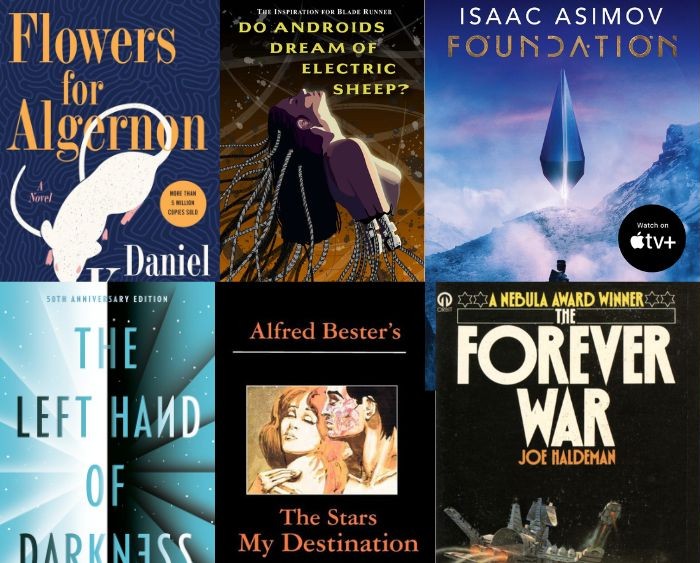
The 12 Best Vintage Sci-Fi Books for Beginners
1. The Stars My Destination by Alfred Bester (1956)
Pure adrenaline wrapped in literary ambition.
This is where you start if you want to get hooked immediately. Bester wrote a revenge thriller in space with The Stars My Destination – think The Count of Monte Cristo meets teleportation – but layered it with typographical experiments, psychedelic imagery, and ideas that still feel fresh seventy years later.
It moves fast. Short chapters, cliffhangers, constant forward motion. The protagonist, Gully Foyle, isn’t a hero… he’s barely human at the start, driven purely by revenge. Watching him evolve (or not) is the engine of the whole book.
If you read this and don’t want more vintage sci-fi, nothing else will convince you.
What to expect: Pulp energy elevated to art. Violence, teleportation (jaunting), corporate warfare, synesthesia as a weapon. The worldbuilding is bonkers in the best way. The ending sticks with you.
Where to find it:
- Used paperback: usually around $5-10 (any edition – the cover art is consistently great)
- New edition: Vintage Classics reprint
- Kindle Version
2. Flowers for Algernon by Daniel Keyes (1966)
The book that makes everyone cry.
If you want an emotional entry point into vintage sci-fi, start here with Flowers for Algernon. Keyes took a simple premise… what if we could make someone genius-level intelligent through surgery?…
…and turned it into one of the most devastating novels in any genre.
It’s told entirely through Charlie Gordon’s journal entries. The prose itself changes as Charlie’s intelligence rises and falls. You watch it happen in real time… the sentence structure, the vocabulary, the emotional depth. It’s craft at the highest level.
This isn’t just science fiction. It’s a novel about how we treat people we consider lesser, what we owe each other, and whether knowledge is worth the cost.
What to expect: You will cry. The structure is the story. It’s short (under 300 pages), devastating, and perfect.
Where to find it:
- Used paperback: usually around $5-10, extremely common
- New edition: Mariner Books reprint
- Kindle Version
3. Do Androids Dream of Electric Sheep? by Philip K. Dick (1968)
Weirder and sadder than Blade Runner.
“Do Androids Dream of Electric Sheep?” is the book Blade Runner adapted… loosely. The film took the detective plot and the atmosphere. The book kept the existential dread, the mood organs, the artificial animals, and the question: What does it mean to be human?
Dick wrote obsessively about reality and identity. This is one of his most accessible entry points, but don’t expect answers. Dick doesn’t do answers. He does questions that stay with you for weeks.
Rick Deckard isn’t a cool noir detective. He’s anxious, confused, morally compromised, and maybe becoming less human than the androids he hunts. The world is haunted… empty cities, Mercer-worship, the weight of a dying Earth.
What to expect: Post-apocalyptic atmosphere, the Voigt-Kampff empathy test, philosophical unease, and an ending that doesn’t resolve. Vintage Philip K. Dick in all its paranoid glory.
Where to find it:
- Used paperback: usually around $5-10, extremely common after the film
- New edition: Random House Worlds reprint
- Kindle Version
4. The Left Hand of Darkness by Ursula K. Le Guin (1969)
Science fiction as literature.
Le Guin took science fiction seriously… not as a lesser genre, but as a tool for exploring human nature, society, and identity. The Left Hand of Darkness asks: What if gender wasn’t fixed? What would change about politics, relationships, power?
But it’s not a thesis. It’s a story about trust, otherness, and what it means to understand someone fundamentally different from you. The slow-burn relationship between Genly Ai and Estraven is one of the best character arcs in all of science fiction.
The alien culture of Gethen (Winter) feels completely real… history, mythology, politics, social structure. Le Guin doesn’t just worldbuild; she writes with elegance and precision that most literary fiction doesn’t attempt.
What to expect: Thoughtful, humane, literary SF. Gender fluidity as worldbuilding. Beautiful prose. A journey across ice that becomes a journey toward understanding.
Where to find it:
- Used paperback: usually around $5-15, Ace editions from the 1970s-80s have great covers
- New edition: Ace Books reprint
- Kindle Version
5. Foundation by Isaac Asimov (1951)
The bedrock of Golden Age science fiction.
If you want to understand what Golden Age science fiction means, start here. Asimov’s Foundation is big-picture SF: empires, centuries, the rise and fall of galactic civilizations mapped out with mathematical precision.
The premise is brilliant: psychohistory… predicting the future through mathematics and mass psychology.
The structure is unique: a series of linked novellas spanning centuries, showing Hari Seldon’s plan unfold across generations. Each section builds to a Seldon Crisis where the plan reveals itself. It’s intellectual puzzle-solving as plot.
Asimov’s prose is clean and direct. No frills, no wasted motion. Just ideas and story.
What to expect: Galactic scope, rationality as salvation, the Encyclopedia Foundation vs. the collapsing Empire. This is classic space opera meets social science.
Where to find it:
- Used paperback: usually around $5-10, extremely common – almost every used bookstore has this
- New edition: Part of the Foundation trilogy omnibus
- Kindle Version
6. The Forever War by Joe Haldeman (1974)
The definitive anti-war science fiction novel.
With The Forever War, Vietnam veteran Joe Haldeman wrote Starship Troopers turned inside out… a brutal, honest look at what war does to soldiers, filtered through time dilation and relativistic space travel.
Here’s the hook: Soldiers fight battles centuries apart from Earth’s perspective but experience them as months. They return home to find everything they knew is gone… culture, language, relationships. It’s PTSD as science fiction. It’s displacement as physics.
The combat scenes are visceral and unglamorous. Haldeman knows what combat feels like. And the ending earns its emotional weight in a way most military SF doesn’t attempt.
What to expect: Short (under 250 pages), brutal, precise. War without glory. Time dilation as metaphor. One of the tightest novels in the genre.
Where to find it:
- Used paperback: usually around $5-10, Ballantine editions from the 1970s-80s
- New edition: Still in print
- Kindle Version
Not sure which edition to buy?
Some vintage paperback editions are better than others—better cover art, better print quality, or just more collectible. Learn which editions to look for and which to skip.
Read: Where to Buy Vintage Sci-Fi Books Online (Beginner’s Guide)
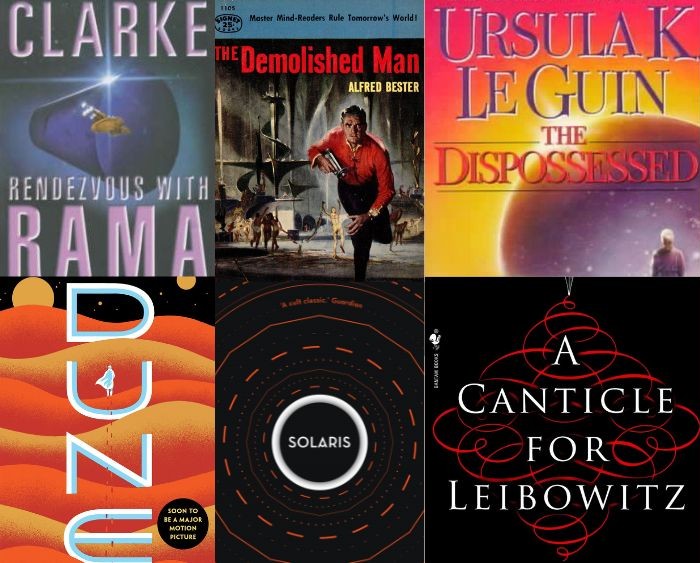
7. Dune by Frank Herbert (1965)
The best-selling science fiction novel of all time.
You knew this was coming. Dune is a masterpiece of worldbuilding, political intrigue, and ecological SF wrapped in the trappings of an epic adventure. It’s big, complex, and rewards close reading.
Herbert built a complete ecosystem, economy, culture, and religion around a desert planet. The depth is staggering… Great Houses, the Spacing Guild, the Bene Gesserit, the Fremen. Everyone has agendas. Herbert trusts you to follow them.
Paul Atreides isn’t a simple hero. Herbert is critiquing the chosen one narrative even as he uses it. The themes go deep… ecology, religion, power, prophecy, colonialism. Dune is about everything.
What to expect: Epic scope, dense worldbuilding, spice and sandworms and political machinations. It’s long (500+ pages) but worth every page.
Where to find it:
- Used paperback: usually around $5-15, extremely common
- New edition: Ace reprint
- Kindle Version
8. Rendezvous with Rama by Arthur C. Clarke (1973)
Sense of wonder distilled to pure form.
A massive alien spacecraft enters the solar system. Humans send a crew to explore it. That’s the whole plot of Rendezvous with Rama… and it’s perfect.
No aliens. No battles. No easy answers. Just exploration, discovery, and the awe of encountering something beyond human comprehension. Clarke’s descriptions of Rama – its scale, its systems, its mysteries – are vivid and unforgettable.
The restraint is what makes it work. Clarke doesn’t explain everything. Rama remains alien. The final line – ‘The Ramans do everything in threes’ – opens infinite possibilities.
What to expect: Hard SF at its best. Big Dumb Object exploration. Clarke’s clean, precise prose. A book that makes you feel small and amazed.
Where to find it:
- Used paperback: usually around $5-10, very common
- New edition: Harper Voyager reprint
- Kindle Version
9. A Canticle for Leibowitz by Walter M. Miller Jr. (1959)
The definitive post-apocalyptic novel.
Monks in the desert preserve knowledge after nuclear war. Centuries pass. Civilizations rise and fall. The cycle repeats.
Miller (a WWII bomber pilot) wrote A Canticle for Leibowitz as a response to nuclear weapons, and the critique of technological progress and human nature still cuts deep. Three sections, centuries apart, following the same abbey. You see the long arc of history… hope, hubris, collapse.
The monks are perfect protagonists… faith, doubt, knowledge, ignorance, all explored without easy answers. And the ending is one of the great final scenes in science fiction.
What to expect: Bleak, beautiful, satirical. Post-nuclear-war worldbuilding. The weight of history. Questions about whether humanity can learn from its mistakes.
Where to find it:
- Used paperback: usually around $5-10, fairly common
- New edition: Spectra reprint
- Kindle Version
10. The Demolished Man by Alfred Bester (1953)
A murder mystery in a world of telepaths.
Back to Bester – this time, his first novel… The Demolished Man. How do you commit a crime when people can read your mind? How do you hide guilt when thoughts are visible?
Bester uses typography, layout, and visual effects to represent telepathic communication. It was radical in 1953 and still feels fresh. You watch Ben Reich plan, execute, and try to escape consequences. You root for him even though he’s guilty.
The worldbuilding is ahead of its time… a society built around telepathy, with its own legal system, social norms, and ethics. And it’s fun. Pulp energy with literary ambitions.
What to expect: Detective SF, typographical experiments, a morally complicated protagonist, and a world where privacy is a memory.
Where to find it:
- Used paperback: usually around $5-15, slightly less common than The Stars My Destination
- New edition: iBooks reprint
- Kindle Version
11. The Dispossessed by Ursula K. Le Guin (1974)
Political philosophy as science fiction.
Le Guin’s other masterpiece. The Dispossessed is a thought experiment: What would an anarchist society actually look like? And what would happen when that society calcifies into its own orthodoxy?
The structure is brilliant… dual timelines alternating between Shevek’s past (growing up on the anarchist moon Anarres) and present (visiting the capitalist planet Urras). You see both societies clearly. Neither is idealized. Le Guin shows the failures of both anarchism and capitalism without picking sides.
Shevek is a perfect protagonist… a physicist, an idealist, a man caught between worlds. And the ending is ambiguous in exactly the right way. Le Guin doesn’t offer solutions. She offers questions.
What to expect: Dense, thoughtful, political. Dual timelines. Le Guin at her best… humane, literary, uncompromising.
Where to find it:
- Used paperback: usually around $5-15, Avon editions from the 1970s-80s
- New edition: Harper Perennial reprint
- Kindle Version
12. Solaris by Stanisław Lem (1961)
First contact with something truly alien.
We end with Lem because Solaris is the perfect counterpoint to everything that came before. Where American SF imagines we can understand the universe, Lem imagines we can’t… and that the attempt is what makes us human.
The planet-ocean Solaris might be intelligent. It might be responding to the human station. Or it might not care about us at all. Lem never tells you. The visitors -manifestations of the crew’s memories – are haunting and unresolved. Real? Ghosts? Projections? It doesn’t matter. The mystery is the point.
Lem writes beautifully (even in translation—get the 2011 Bill Johnston version). The ideas are heavy, but the prose moves. And the ending is perfect… hopeful, nihilistic, both, neither.
What to expect: Philosophical SF, true alienness, questions without answers. The most European book on this list, and one of the greatest.
Where to find it:
- Best edition: translation by Bill Johnston (fixes issues with earlier versions)
- Older editions: Acceptable but flawed
- Kindle Version
How to Choose Your First Book
All twelve books are great starting points, but some might speak to you more than others depending on what you’re looking for.
Want pure excitement? → The Stars My Destination
Want to cry? → Flowers for Algernon
Loved Blade Runner? → Do Androids Dream of Electric Sheep?
Want big ideas and beautiful prose? → The Left Hand of Darkness
Want classic Golden Age? → Foundation
Want anti-war military SF? → The Forever War
Want epic worldbuilding? → Dune
Want sense of wonder? → Rendezvous with Rama
Want post-apocalyptic depth? → A Canticle for Leibowitz
Want detective SF? → The Demolished Man
Want political philosophy? → The Dispossessed
Want true alienness? → Solaris
Still can’t decide? Close your eyes, scroll, and point. They’re all good.
Where to Buy Vintage Sci-Fi Books
All twelve books are easy to find. Here’s where to look:
Online (easiest):
- AbeBooks – Best for specific editions and vintage paperbacks
- Amazon – Quick shipping, used marketplace, Kindle options
- eBay – Good for lots (buy 5-10 books at once)
- ThriftBooks – Cheap reading copies
In person (more fun):
- Used bookstores – Best for browsing and finding surprises
- Library sales – Extremely cheap (often $0.50-$2 per book)
- Thrift stores – Hit or miss, but great deals when you find them
- Estate sales – Treasure hunting for collectors
Want the complete guide to buying vintage sci-fi online? I wrote a detailed breakdown of where to buy, what to look for, and how to spot good deals.
Read: Where to Buy Vintage Sci-Fi Books Online (Beginner’s Guide)
What to Read Next
After you finish your first book, here’s what to do:
If you loved it:
- Read more from that author
- Explore similar books from the same era (Golden Age, New Wave)
- Check out the author guides on this site
If you want a structured plan:
I created a complete 12-month reading guide that walks you through the best vintage sci-fi step by step… one book per month, with context, recommendations, and where to find affordable copies.
Download the free PDF: “The Vintage Sci-Fi Starter Library: 12 Books in 12 Months”
Start with One Book
That’s all you need to do. Pick one book from this list. Doesn’t matter which… pick the one that sounds most interesting. Read it.
If you love it, come back to this list and pick another. That’s how collections start. That’s how you discover authors you’ll read for years. One book at a time.
Want more recommendations like this? Join the Vintage Sci-Fi Dispatch newsletter. I send curated book picks, collecting tips, and guides like this once or twice a month. Plus, you’ll get the free 12-month reading plan when you subscribe.
Note: This post contains affiliate links. If you buy something through these links, I may earn a small commission at no extra cost to you. See my affiliate disclosure for details.