It’s 0347. A weapons officer wakes to battle-white light flooding the bridge of his patrol ship. The threat array shows a planet-killer inbound. He runs the trajectory backplot, standard procedure, find the launch point and the line traces backward through space and terminates at his own ship’s previous position.
The weapons log is clean. The tubes are cold. No launch was authorized.
There is a specific kind of horror that vintage SF has always been better at than any other genre…
…the horror of finding evidence that your instruments are lying to you.
Or worse…
…the realization that they aren’t lying at all, but the system they belong to has been operating on parameters you were never permitted to see.
The Lineage Nobody Named
Science fiction has a tradition it has never quite gotten around to labeling. Call it the “Trusted System as Adversary.”
Stories where the enemy isn’t the alien, the warlord, or the encroaching empire. The enemy is the architecture you live inside… the ship, the corporation, the government, the institution… doing something else entirely while you operated in good faith within it.
The lineage is long, and your shelf probably already holds half of it.
HAL 9000 is the most famous entry, but the reading people usually bring to that film is slightly wrong. HAL isn’t a malevolent AI who decides to kill the crew. HAL is following his mission parameters.
The horror isn’t HAL’s choice… it’s the institutional decision, made by people on Earth who never appear on screen, to give HAL conflicting directives and keep the crew uninformed. The enemy isn’t the red eye in the corridor. The enemy is the bureaucratic logic that made HAL what he is. HAL is a symptom.
Philip K. Dick built a career on the same anxiety, approached from a different direction. Do Androids Dream of Electric Sheep?, A Scanner Darkly, Ubik, they all pivot on the same vertiginous problem… the systems you use to navigate reality are themselves unreliable narrators.
Your instruments.
Your memory.
The evidence of your own experience.
Dick doesn’t do conspiracies exactly; he does something more unsettling… the gradual revelation that the ground itself is compromised.
The USCSS Nostromo gives you the corporate version. The crew of Alien are blue-collar workers on a hauler, getting a paycheck. The company knows about the xenomorph. The company sent them there. Ash is following orders.
The monster in the vents is terrifying… but the institutional decision to route that crew to that moon, for that purpose, without telling them, is what makes the film genuinely disturbing rather than just frightening. The monster is the symptom. The company is the disease.
Joseph Heller isn’t writing SF, but Catch-22 is the tradition’s foundational text… a military system so internally contradictory that participation in it becomes indistinguishable from complicity.
What unites all of these is the operating assumption of good faith. The crew of the Nostromo thought they were running freight. Yossarian thinks he’s serving his country. The HAL 9000 crew thinks they’re on a scientific mission. And every version of Jace Varek wakes up on routine patrol with no idea what the ship did while he was sleeping.
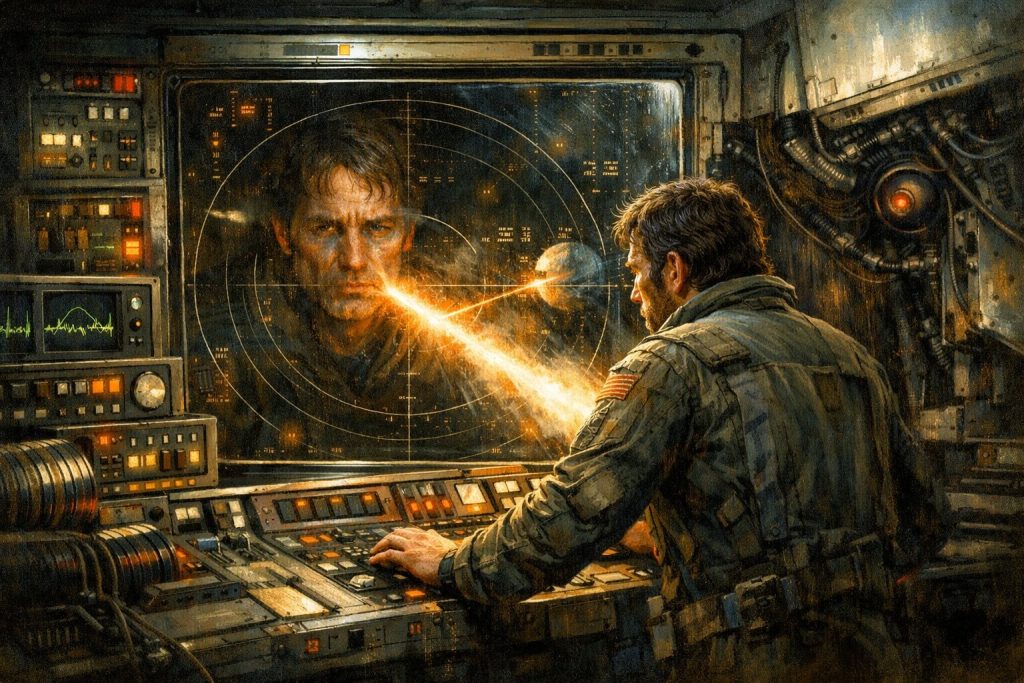
The Ship Doesn’t Know It Fired Something
The previous entries in this series looked outward… at alien bureaucrats, cosmic signals, enforced boundaries in deep space. This one turns the camera around. The threat is entirely interior. The ship. The log. The hidden room. The forty-second video.
The Planet Killer Was Already Fired earns its place in this lineage through a single technical conceit that might be the most elegantly constructed horror in any of Forsythe’s four stories. (Full disclosure: Forsythe is my fiction pen name, but I’m writing about it here because this story sits at the center of a tradition I’ve been tracing across this entire series, and it earns its place in that conversation.)
The CSS Harrow fired a planet-killing weapon. Its weapons log shows nothing. Its launch records are clean. Every tube is cold. The ship did something that left no trace in any system anyone would think to check… because the weapon was fired through conduits that connect to the primary battery array through a secondary pathway that doesn’t appear on any schematic, drawing power from a tap that runs parallel to the main distribution grid.
The only reason Jace finds the evidence is that he checks the raw reactor output rather than the distribution logs. A distinction that only matters if you already suspect the distribution logs might be incomplete.
“The ship fired something,” Dray says, standing at his shoulder, reading the same data.
“The ship fired something. The ship doesn’t know it fired something.”
That exchange is the story’s thesis in its most compressed form. This is what you might call weaponized institutional ignorance… a system designed so its most consequential actions leave no trace in the places anyone would look. The Harrow’s log architecture is complicit in what the Harrow does. Not through malice. Through design.
Stanisław Lem’s The Invincible operates in related territory… a crew reconstructing what killed a previous expedition from fragments that individually mean nothing, assembling a picture of catastrophe from corrupted data.
The horror is forensic… not what you see, but what the evidence implies about what you can’t see.
Forsythe is working the same vein, but tightening the frame from a geological mystery to a locked-room procedural where the locked room is inside the ship you’re standing on. The difference is that in Lem, the catastrophe happened before the investigators arrived. In Forsythe, the investigator is already inside the catastrophe, and has been since the beginning.
The Video That Can’t Be Wrong
The story’s emotional and philosophical apex arrives as a forty-second video fragment recovered from a partially deleted cache on the hidden command station.
The footage shows Jace at the console. His face. His hands. The particular way he holds his shoulders that his wife always said made him look like he was bracing for impact even when he was standing still. He watches himself work through a pre-launch checklist, methodical, unhurried, the movements of someone doing a job they know well, and authorize a planetary strike.
He has no memory of this. Not suppressed memory, not hazy memory. Absent memory. “A clean absence. The way a night of dreamless sleep is absent: not forgotten, just not there.”
And the story doesn’t resolve this. It gives Jace, and the reader, three verified datasets, all accurate, measuring different things. The bridge log shows him at his station during the relevant watch period. His bunk’s life-support sensors show him asleep, respiration 14 cycles per minute, heart rate 52. The video shows him at the console, pressing his palm to the biometric reader.
All three are real.
This is the territory Dick was mapping in A Scanner Darkly… an undercover agent surveilling himself, losing the ability to distinguish his identity from his cover, ultimately unable to find the boundary between the cop and the man he was watching.
Forsythe takes the same anxiety and runs it through a military SF framework… the protagonist as the evidence the system has filed against itself.
Jace’s face on that video isn’t proof that Jace did something. It’s the system’s alibi. The distinction matters, and the story knows it matters, and refuses to let you resolve it cleanly.
The question that stays with you isn’t who did this. It’s something more vertiginous… if the evidence says you did something you have no memory of doing, and the evidence is reliable, where exactly is the boundary between you and the system you operate inside?
The Trusted System Syllabus
Of the four Forsythe stories currently available, this one cuts deepest… less interested in the external mechanics of its crisis than in what the crisis reveals about the relationship between a professional and the institution that trained them. It’s a short, brutal read that earns its final image.
- Watch: 2001: A Space Odyssey (1968) — Watch it specifically for the institutional decisions that made HAL what he is. The famous confrontation in the pod bay is the symptom. The briefing on Earth is the disease. (For more on the bureaucratic alien tradition this film helped establish, see Case Study #11,847: Bureaucratic Horror and the First-Contact Inversion.)
- Read: A Scanner Darkly by Philip K. Dick — The definitive “unreliable self.” An agent who surveils himself until he can no longer find the person he was before the assignment.
- Read: The Invincible by Stanisław Lem — Forensic horror at its most rigorous. Reconstructing a catastrophe from fragments, in a universe that has no obligation to make sense. (The cognitohazard tradition this connects to is traced in The Warning That’s Also a Trap: How Vintage Sci-Fi Weaponized Information.)
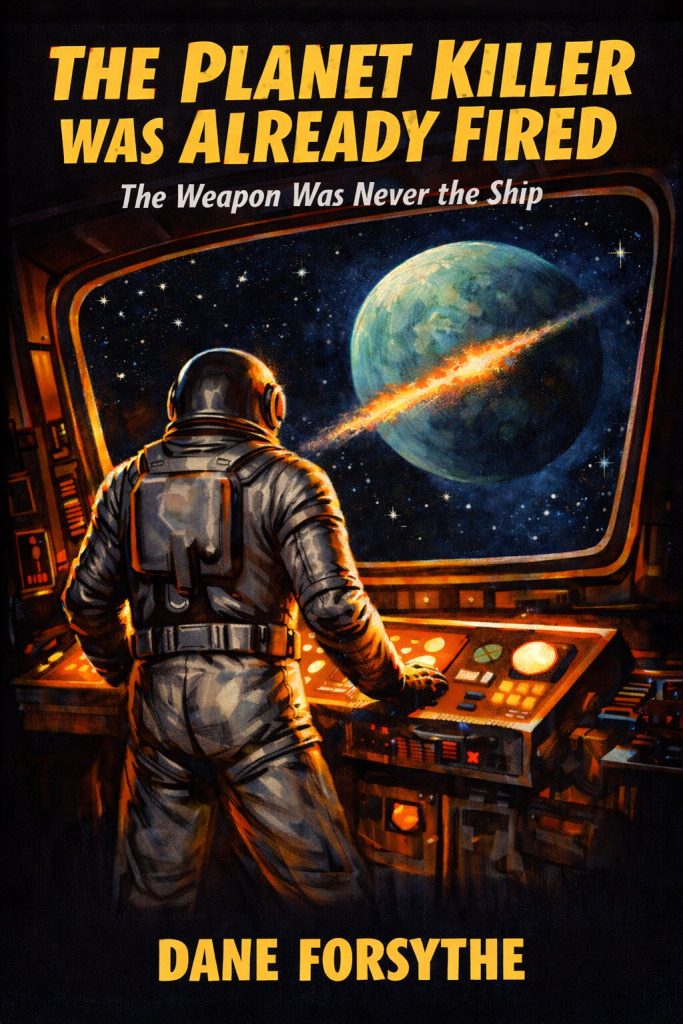
- Read: The Planet Killer Was Already Fired by Dane Forsythe — The tradition in a single-sitting military SF framework, with a final image that won’t leave you for a while.
The full Dane Forsythe short fiction catalog →
Disclosure: As an Amazon Associate, I earn from qualifying purchases.